

Have you ever typed “manuel” instead of “manual” and wondered if it even mattered? You’re not alone. This tiny one-letter mix-up is one of the most surprisingly common spelling errors in everyday English writing and it happens to students, professionals, and native speakers alike.
Here’s the thing: these two words are not interchangeable. Not even close. One is a proper name with cultural roots spanning centuries.
The other is a versatile English word that shows up in instruction booklets, job descriptions, car dashboards, and musical instruments. Swapping them doesn’t just look careless, it can completely change the meaning of your sentence.
Think about it this way: if you email a client and write “please refer to the attached Manuel for setup instructions,” you’ve just told them that a person named Manuel is their setup guide.
It’s the kind of mistake that gets screenshotted and shared, not exactly the professional image most of us are going for.
In this guide, we break down Manuel vs Manual in plain, clear language. You’ll learn their definitions, origins, correct usage, common mistakes to avoid, and real sentence examples.
Whether you’re a student, a content writer, an ESL learner, or just someone who wants to nail their grammar once and for all by the end, you’ll never second-guess which one to use again.
Manuel vs Manual : Quick Comparison Table
| Quick Comparison | Manuel | Manual |
| Type | Proper noun (name) | Common noun / adjective |
| Meaning | A person’s name | Instruction guide / done by hand |
| Origin | Spanish/Portuguese (Emmanuel) | Latin (manualis → manus) |
| Capitalization | Always capitalized | Lowercase (unless starting a sentence) |
| Example | Manuel joined the team today. | Read the manual first. |
Definitions Of Manuel vs Manual
Before diving into usage rules and sentence examples, let’s get the definitions straight. Understanding what each word actually means is the foundation of using them correctly.
Definition Of Manuel
Manuel is a proper noun specifically, a masculine given name widely used in Spanish, Portuguese, and French-speaking cultures. It is the Iberian equivalent of the Hebrew name Emmanuel, which translates to “God is with us.”
Because it is a proper noun, Manuel always begins with a capital letter, regardless of where it appears in a sentence. You would never write “manuel” in lowercase when referring to a person’s name that would be a spelling error.
Some quick facts about the name Manuel:
- Origin: Spanish and Portuguese, derived from Hebrew “Emmanuel”
- Meaning: “God is with us”
- Common nickname: Manny
- Usage: First name for males across Latin American, Spanish, and European cultures
- Notable figures: Manuel Noriega (former Panamanian leader), Manuel Neuer (German goalkeeper), Manuel de Falla (Spanish composer)
- Geographical use: Manuel is also the name of a municipality in Valencia, Spain
In a sentence, Manuel functions as a subject, object, or indirect object just like any other proper name. The key rule: if you’re referring to a person or place named Manuel, always capitalize it.
Definition Of Manual
Manual is a common English word that functions as both a noun and an adjective. Its roots trace back to the Latin word manualis, itself derived from manus, meaning “hand.”
This origin explains why “manual” consistently relates to things involving human hands, direct effort, or physical control.
Here’s how manual is used across different contexts:
As a noun:
- An instruction book or handbook: “Read the manual before assembling the furniture.”
- A keyboard on an organ or harpsichord played with the hands: “The organist practiced on the lower manual.”
- A vehicle with manual transmission (informal): “She drives a manual.”
As an adjective:
- Done by hand, not by machine: “Manual labor is physically demanding.”
- Operated or controlled by a person rather than automatically: “The machine has a manual override switch.”
- Requiring human effort or physical skill: “This job involves a lot of manual dexterity.”
Key definitions at a glance: Manuel vs Manual
| Aspect | Details |
| Word type | Noun and adjective |
| Latin root | Manualis → manus (hand) |
| As a noun | Instruction book, handbook, organ keyboard, manual car |
| As an adjective | Done by hand, hand-operated, requiring human skill |
| Capitalization | Lowercase, unless starting a sentence |
| Correct spelling | M-A-N-U-A-L |
One important note: “manuel” written in lowercase is not a valid English word. If you see it written that way without referring to a person’s name, it’s a spelling mistake that should be corrected to “manual.”
Manuel vs Manual Book
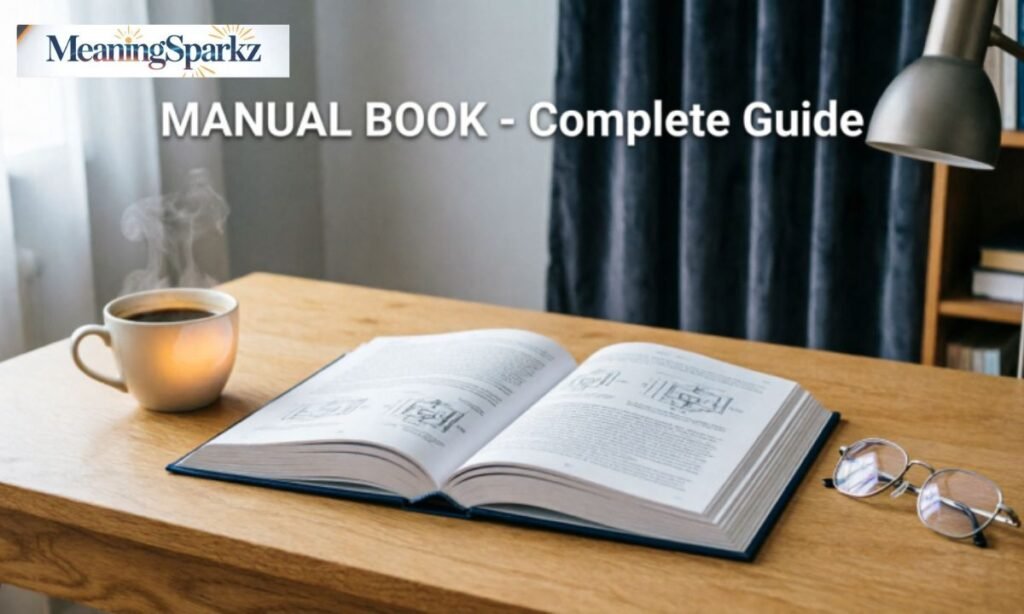
This is where a lot of the confusion happens. People sometimes write “manuel” when they mean an instruction guide as in, “I lost the manuel for my router.”
That sentence contains a clear error. When referring to a book of instructions or a user guide, the correct word is always manual, spelled M-A-N-U-A-L.
A manual (the book) is a printed or digital document that provides step-by-step instructions for operating, maintaining, or understanding a product, system, or process. You’ll find manuals for:
- Electronics and appliances user manuals for phones, laptops, and washing machines
- Vehicles owner’s manuals for cars, motorcycles, and trucks
- Workplace processes employee handbooks and training manuals
- Software technical reference manuals and developer guides
- Medical equipment clinical operation manuals
Common phrases that use “manual” as a noun include:
- Instruction manual
- User manual
- Owner’s manual
- Reference manual
- Training manual
- Repair manual
- Employee manual
Memory tip: Think of the Latin root manus (hand). A manual is a handbook literally a guide you hold in your hands. It has nothing to do with a person named Manuel.
If you ever catch yourself writing “the manuel says…” stop, backspace, and replace it with “the manual says…” Every single time.
Click Here See More ….
Manual vs Manuel Meme
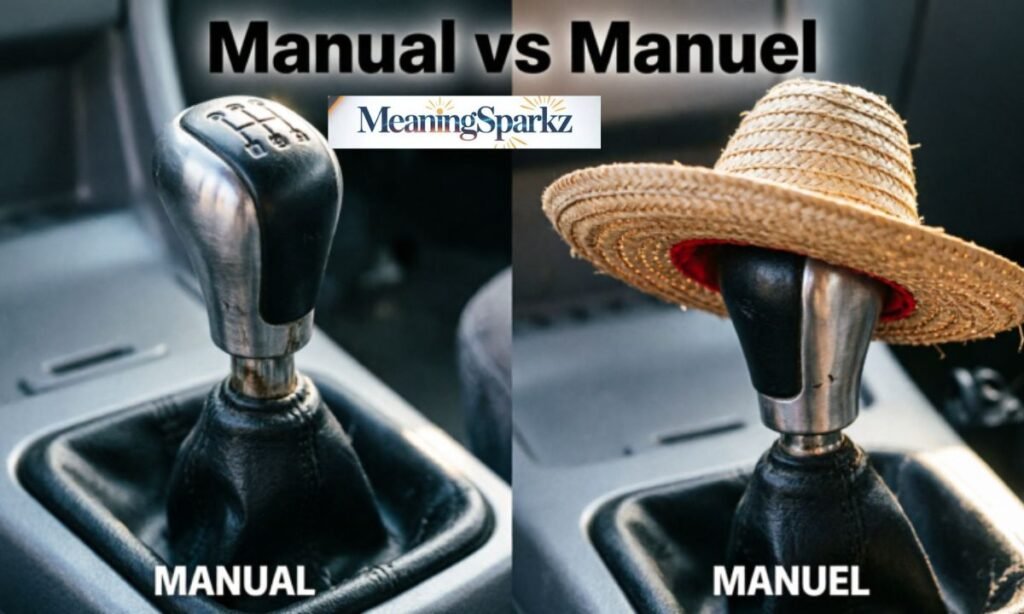
The confusion between “manual” and “Manuel” has taken on a life of its own online, spawning a wave of jokes and memes that highlight how awkward the mix-up can be in real life.
The most classic version of the manual vs manuel meme usually involves an instruction booklet or product guide that someone humorously refers to as “Manuel” implying that a person (not a document) wrote the instructions and is personally responsible for your confusion.
These memes often appear in formats like:
- “Can’t figure out this IKEA furniture. I blame Manuel.”
- “The manuel says to press the red button… thanks Manuel, very helpful.”
- “When you read the manuel and still have no idea what you’re doing.”
There’s even a popular running joke referencing Manuel from the classic British sitcom Fawlty Towers, a Spanish waiter character known for his cheerful cluelessness. When people misspell “manual” as “Manuel,” the joke practically writes itself.
Beyond humor, these memes actually serve a useful purpose: they make the spelling difference memorable. After seeing the joke a few times, it’s hard to forget that Manuel is a person and manual is a document. Comedy, it turns out, is one of the best memory aids.
How To Properly Use Manuel vs Manual In A Sentence
Now let’s get practical. Knowing the definitions is one thing. Using these words correctly in real writing is another. Below are clear rules for when and how to use each one.
How And When To Use Manuel
Use Manuel only when referring to:
- A person named Manuel This is by far the most common use. If you’re writing about someone whose name is Manuel, use it as you would any other proper name.
- A place named Manuel Such as the municipality of Manuel in Valencia, Spain.
Grammar rules for using Manuel:
- Always capitalize the M, regardless of where it appears in the sentence
- It can function as a subject (Manuel arrived early), an object (I called Manuel), or part of a possessive (Manuel’s report was excellent)
- Never use it to refer to a book, a process, or a task
- Do not use it as an adjective to describe actions or objects
Correct usage examples:
✅ Manuel is the most experienced technician on the team.
✅ I forwarded the email to Manuel for review.
✅ The award was presented to Manuel at the ceremony.
✅ Have you spoken with Manuel about the new schedule?
Incorrect usage (avoid these):
❌ Please check the Manuel before proceeding. (Should be: manual)
❌ The machine runs on manuel power. (Should be: manual)
❌ I read the manuel cover to cover. (Should be: manual)
How And When To Use Manual
Use manual in the following contexts:
- As a noun when referring to an instruction book, handbook, or guide
- As an adjective when describing something operated or done by hand
- In automotive contexts when referring to a vehicle with manual transmission
- In music when referring to a keyboard on an organ played with the hands
- In workplace or professional settings to describe tasks requiring direct human effort
Correct usage examples:
✅ Please refer to the user manual before contacting support.
✅ This is manual work no machines are involved.
✅ He learned to drive a manual when he was seventeen.
✅ The organ has two manuals and a full pedalboard.
✅ Manual labor builds physical endurance over time.
✅ The manual override switch is located on the back panel.
Quick capitalization rule:
Only capitalize “manual” if it begins a sentence. In all other positions, keep it lowercase.
Manuel vs Manual Reddit
The question of Manuel vs Manual comes up more often than you’d expect on Reddit particularly in communities like r/grammar, r/writing, r/learnEnglish, and r/mildlyinfuriating.
Some of the most common discussions include:
- Autocorrect complaints: Users report that their phones sometimes auto-correct “manual” to “Manuel,” especially if they have a contact named Manuel. This leads to embarrassing emails and texts.
- Workplace errors: Several Reddit threads feature screenshots of official workplace documents or product labels that accidentally say “See Manuel for instructions” implying an employee named Manuel is the instruction guide.
- ESL learners: Non-native English speakers frequently ask whether “manuel” is an alternate spelling of “manual.” The answer, as we’ve established, is no “manuel” in lowercase is not a valid English word.
- Meme appreciation: Threads in humor subreddits celebrate the comedic confusion, turning the misspelling into relatable content.
The takeaway from Reddit consensus is clear: the words are not interchangeable, spell-check won’t always save you (because “Manuel” is a legitimate proper noun), and the best defense is simply knowing the difference before you type.
Examples Of Manuel vs Manual Use In Sentences
One of the most effective ways to internalize the difference between these two words is to see them used correctly in real sentence contexts. Here’s a comprehensive collection of examples.
Example Sentences of Manuel
These sentences all use Manuel correctly as a proper name:
- Manuel submitted the quarterly report ahead of schedule.
- I had a long conversation with Manuel about the project timeline.
- Doctor Manuel examined the patient and recommended further testing.
- Manuel has lived in Barcelona for the past ten years.
- The keynote speech was delivered by Manuel, the company’s founder.
- We’re waiting for Manuel to confirm the meeting details.
- Manuel’s attention to detail has made him indispensable to the team.
- Has anyone heard from Manuel since the conference?
- Manuel and his team completed the renovation in record time.
- The scholarship was awarded to Manuel for academic excellence.
Example Sentences of Manual
These sentences use manual correctly as both a noun and an adjective:
As a noun (instruction guide):
- The technician consulted the repair manual before replacing the component.
- Every new employee receives a training manual on their first day.
- I downloaded the user manual as a PDF from the manufacturer’s website.
- The manual clearly states that the device should not be used near water.
- We need to update the operations manual to reflect the new procedures.
As an adjective (done by hand / hand-operated):
- The factory still uses manual inspection for quality control.
- Manual labor was the backbone of the construction industry for centuries.
- This setting allows manual control of the camera’s exposure.
- She has exceptional manual dexterity from years of playing the piano.
- The pump can be operated manually if the power supply fails.
In automotive context:
- Learning to drive a manual requires patience and coordination.
- He prefers a manual transmission because it gives him better road control.
- Manual cars are increasingly rare in modern dealerships.
In musical context:
- The cathedral organ features three manuals and an intricate pedalboard.
Manual vs Automatic
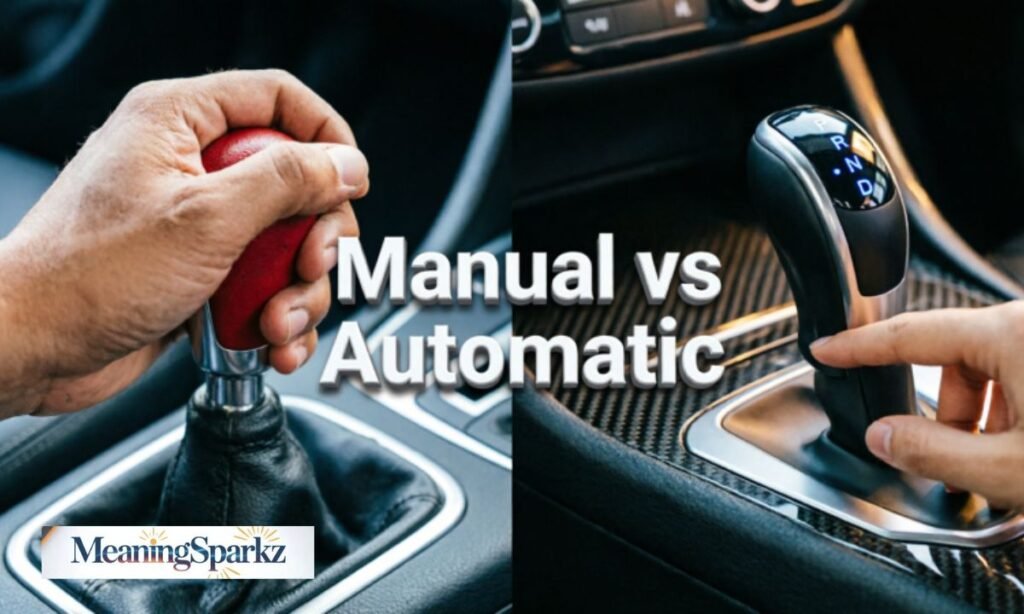
One of the most practical and well-known uses of the word “manual” appears in the automotive world, the manual vs automatic transmission debate. This is a question millions of drivers face when buying a car, and it’s worth understanding clearly.
What Is a Manual Transmission?
A manual transmission (also known as a stick shift or standard transmission) requires the driver to operate a clutch pedal and gear stick to change gears manually. The driver decides when to shift based on speed, engine RPM, and road conditions. It puts you fully in control of the vehicle’s power delivery.
What Is an Automatic Transmission?
An automatic transmission handles all gear changes on its own using a computerized system and hydraulic torque converter. The driver simply selects “Drive” and focuses on steering and braking. No clutch pedal, no gear stick, the car does the shifting work for you.
Manual vs Automatic: Key Differences
| Feature | Manual | Automatic |
| Gear shifting | Driver shifts manually using clutch + stick | Car shifts automatically |
| Learning curve | Steeper requires coordination | Easier for beginners |
| Upfront cost | Typically lower | Usually higher |
| Maintenance cost | Generally lower | Higher due to complexity |
| Fuel efficiency | Can be more efficient with skilled driver | Improving, now comparable |
| Driver control | Full control over gear selection | Limited direct control |
| Performance feel | More engaging and connected | Smoother and more convenient |
| Traffic driving | More effort in stop-and-go traffic | Easier and less fatiguing |
| Resale value | Often lower (fewer buyers know how to drive one) | Generally higher resale value |
| Availability | Declining fewer models offer manual | Widely available across all segments |
Which Is Better Manuel vs Manual?
The honest answer: it depends on your priorities.
- Choose a manual if you enjoy driving engagement, want lower ownership costs, and drive frequently on open roads or highways.
- Choose an automatic if you commute in heavy city traffic, prefer ease and comfort, or are a newer driver still building confidence.
As of 2026, automatic transmissions have become the dominant choice globally, with manual vehicles representing a small and shrinking share of new car sales particularly in North American markets. However, driving enthusiasts and performance car fans still champion the stick shift for the tactile, connected driving experience it provides.
Why Do People Confuse Manuel vs Manual?
Understanding the root causes of this confusion can help prevent future mistakes. There are several reasons this error is so persistent:
1. They sound nearly identical Manuel vs Manual
In casual speech, especially when speaking quickly, “Manuel” and “manual” are almost indistinguishable. The difference in pronunciation is subtle “MAN-yoo-ul” vs. “MAN-uh-wel” and in fast conversation, the distinction can blur completely.
2. They look almost the same in writing Manuel vs Manual
Just one letter separates them. The brain, especially when typing quickly or skimming, can easily overlook the difference between an “e” and an “a” in the middle of a word.
3. Autocorrect works against you Manuel vs Manual
If you have a contact named Manuel on your phone or computer, autocorrect may “helpfully” change “manual” to “Manuel” particularly in typed messages and emails. This is a known issue that even careful writers fall victim to.
4. Spell-check doesn’t catch it Manuel vs Manual
Because “Manuel” is a valid proper noun, most spell-check software treats it as correct. The tool checks spelling, not context so it won’t flag “See the attached Manual for setup instructions” as an error.
5. ESL interference Manuel vs Manual
For non-native English speakers whose native language uses “manuel” as a common word (this doesn’t apply widely, but spelling confusion from similar words in other languages does occur), the mix-up can feel natural.
How to Remember the Difference Forever Manuel vs Manual
Here are three simple memory tricks that make the distinction stick:
- Think of the Latin root: Manus means “hand” in Latin. A manual is a handbook. Hands have nothing to do with a person named Manuel.
- Capitalization is your clue: If the word isn’t capitalized and it’s not starting a sentence, it should be manual. Capital M in the middle of a sentence? That’s Manuel (a name).
- The person test: Ask yourself, am I talking about a human being? If yes, use Manuel. If you’re talking about a document, a task, or a machine, use manual.
Conclusion (Manuel vs Manual)
The difference between Manuel vs Manual comes down to one fundamental distinction: one is a name, the other is a word.
Manuel always capitalized, always referring to a person or place. It carries cultural heritage from Spanish, Portuguese, and Hebrew roots, meaning “God is with us.” It belongs in sentences about people, not products.
Manual is always lowercase (unless starting a sentence), used as a noun for instruction guides and handbooks, or as an adjective for anything hand-operated or requiring direct human effort. It belongs in technical writing, job descriptions, automotive contexts, and everyday communication about tasks and tools.
The confusion between them is understandable; they look nearly identical, sound similar in casual speech, and autocorrect doesn’t always catch the context error. But once you understand the core difference, it becomes instinctive.
Here’s the simplest rule you’ll ever need:
If it’s a person → Manuel
If it’s a guide, a task, or a car transmission → Manual
Use this guide as your reference, share it with anyone who struggles with the same question, and the next time you reach for that instruction booklet, you’ll know exactly which spelling to reach for too.
Frequently Asked Questions (Manuel vs Manual)
What’s the difference between manual and manuel?
Manual is an English word meaning an instruction guide or something done by hand. Manuel is a proper name of Spanish and Portuguese origin. They are not interchangeable, “manuel” in lowercase is not a valid English word.
How do you spell a manual as in a book?
The correct spelling is M-A-N-U-A-L. An instruction manual, user manual, or training manual are all spelled this way. Never use “manuel” when referring to a book or guide.
Is it a manuel or manual car?
It’s a manual car. “Manuel car” is a spelling error. A manual car refers to a vehicle with a manual transmission one that requires the driver to operate a clutch and gear stick.
What do you mean by Manuel?
Manuel is a masculine given name common in Spanish, Portuguese, and French-speaking cultures. It derives from the Hebrew name Emmanuel, meaning “God is with us.” It is a proper noun and always written with a capital M.
