

Some phrases survive for centuries because they say exactly what we mean, in exactly the right number of words. “A day well spent” is one of them.
You’ve probably typed it as an Instagram caption, heard it from a grandparent after a long Sunday, or read it in a motivational quote graphic at least a dozen times.
But is it grammatically correct? Is it overused to the point of being a cliché? And if you’re tired of it, what else can you say instead?
This guide breaks down the meaning, grammar, usage, and freshest alternatives for “a day well spent” with real examples, caption ideas, and quotes you can actually use in 2026.
What Does “Day Well Spent” Actually Mean?
At its core, “day well spent” describes a day that felt worthwhile, one where your time, energy, or effort produced something you’re happy about. That “something” doesn’t have to be productivity in the corporate sense. It can be:
- Finishing a big project or crossing off a long to-do list
- Spending quality time with family or friends
- Resting intentionally without guilt
- Learning a new skill or trying something unfamiliar
- Helping someone else, even in a small way
The phrase carries an emotional undertone of satisfaction and closure. It’s usually said at the end of the day, when you look back and feel content rather than regretful. In short, it’s less about how much you did and more about how meaningful it felt.
Well Spent or Well-Spent?
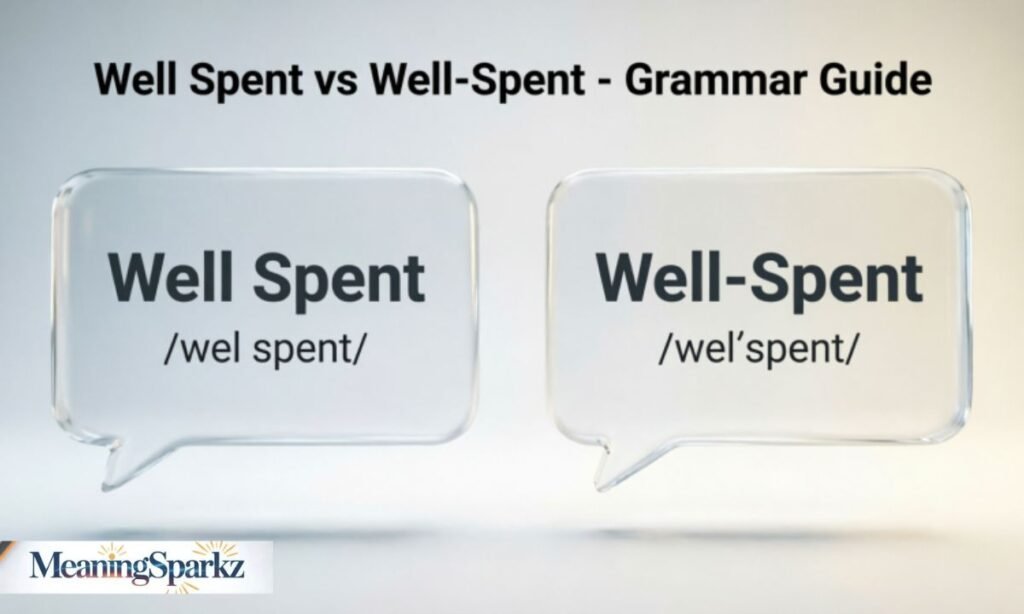
This is one of the most common grammar questions tied to the phrase, and the honest answer is: it depends on where the phrase sits in the sentence.
| Usage | Correct Form | Example |
| Before the noun (attributive) | Hyphenated: well-spent | “It was a well-spent afternoon.” |
| After the noun (predicative) | No hyphen: well spent | “The afternoon was well spent.” |
Here’s the simple rule: when a compound modifier like “well spent” comes directly before the noun it describes, you hyphenate it for clarity. When it comes after the noun (usually after a verb like “was” or “felt”), no hyphen is needed.
- ✅ “That was a well-spent weekend.” (before the noun hyphenated)
- ✅ “The weekend was well spent.” (after the noun no hyphen)
- ✅ “A day well spent” (after the noun it modifies, technically inverted no hyphen; this is the fixed, idiomatic form)
Most style guides, including the Chicago Manual of Style and AP Style, follow this same logic for compound adjectives formed with adverbs ending in “-ly” or comparative-style words like “well.” Since “well” isn’t a true “-ly” adverb, the hyphenation rule for position still applies.
See More…
Day Well Spent Quotes
Quotes about a well-spent day tend to fall into a few themes: gratitude, contentment, purpose, and connection. Here are some original lines capturing that spirit, perfect for reflection, journaling, or sharing:
- “A day well spent isn’t measured by the clock, it’s measured by how full your heart feels at the end of it.”
- “Some days are about doing more. The best days are about feeling enough.”
- “You don’t need a perfect day to call it a day well spent, you just need a present.”
- “The smallest kindness can turn an ordinary Tuesday into a day well spent.”
- “Rest counts. Laughter counts. Showing up counts. That’s what makes a day well spent.”
- “At the end of a day well spent, sleep comes easy and gratitude comes easier.”
- “A day well spent leaves no room for ‘what if’ only ‘thank you.'”
- “Not every well-spent day looks productive from the outside. Some of the best ones look like doing nothing at all.”
These types of quotes work especially well as social captions, journal prompts, or end-of-day affirmations, a small ritual of reflection that reinforces gratitude and mindfulness.
Is It Correct to Say “Day Well Spent”? (Grammar Explained)
Yes, “day well spent” is grammatically correct and widely accepted in both formal and informal English. Here’s why it works:
- “Spent” is the past participle of “spend,” used here as an adjective describing the noun “day.”
- “Well” is an adverb modifying “spent,” describing how the day was used.
- The structure follows a common English pattern: noun + adverb + past participle (compare “a job well done,” “a meal well cooked,” “a life well lived”).
This construction is called a postpositive adjective phrase where the modifying phrase follows the noun instead of preceding it, which is normal for certain fixed expressions in English. That’s why “a day well spent” sounds natural, while “a well-spent day” , though also correct, feels slightly more formal or literary.
Quick correctness checklist:
- ✅ Grammatically valid sentence structure
- ✅ Common in both spoken and written English
- ✅ Recognized in dictionaries and usage guides as an idiomatic phrase
- ✅ Works in singular and plural forms (“days well spent”)
So if you’ve ever second-guessed yourself before posting it as a caption, don’t it’s correct.
Day Well Spent vs A Day Well Spent
Should you drop the article “A” or keep it? Both are correct, but they serve different grammatical roles.
| Phrase | Function | Example |
| Day well spent | Used as a phrase or exclamation on its own | “Day well spent!” |
| A day well spent | Used as a complete noun phrase within a sentence | “Today was a day well spent.” |
- “Day well spent” works well as a standalone caption, headline, or exclamation short, punchy, and social-media-friendly.
- “A day well spent” is the fuller, grammatically complete version, needed when the phrase functions as the subject or object of a sentence.
Example comparison:
- “Day well spent.” (caption style informal, complete on its own as an exclamation)
- “It has been a day well spent.” (full sentence the article “a” is required here)
Neither is “more correct” than the other; the choice comes down to context. Captions and headlines favor the shorter form; full sentences need the article.
Day Well Spent Instagram

This phrase is one of the most-used caption formulas on Instagram, and for good reason it’s short, positive, and pairs with almost any kind of photo, from a hiking trip to a lazy brunch. Here’s how creators typically use it:
- Travel posts: “Sunburnt, sandy, and grateful. Day well spent.”
- Family posts: “Sticky fingers, loud laughs, and a day well spent.”
- Fitness/self-care posts: “Sweat now, smile later. Day well spent.”
- Work milestones: “Deadline crushed. Day well spent.”
- Simple lifestyle posts: “Coffee, sunshine, and nowhere to be. Day well spent.”
Tips for using it effectively on Instagram in 2026:
- Pair it with a specific detail (what you actually did) instead of using it alone specificity boosts engagement.
- Combine it with 2–3 relevant hashtags like #DayWellSpent, #GratefulHeart, or #SlowLiving rather than stuffing dozens.
- Use it as a closing line in longer captions rather than the opening hook, since it works best as a reflective sign-off.
- Match the tone of the photo a chaotic toddler photo and a peaceful sunset photo both work, but the surrounding words should match the mood.
When and Where to Use “Day Well Spent” Correctly
This phrase is versatile, but knowing the right context keeps it from sounding forced. Here’s where it fits naturally:
- Personal reflection: journaling, end-of-day check-ins, gratitude lists
- Social media captions: Instagram, Facebook, LinkedIn (for professional wins)
- Conversations: casual talk with friends or family after an outing
- Greeting cards and messages: thank-you notes after a shared experience
- Marketing and hospitality copy: travel brands, wellness brands, cafés, event recaps
- Workplace communication: wrapping up a productive meeting or project (used sparingly, in informal settings)
Where it fits less naturally:
- Formal business reports or academic writing
- Legal or technical documents
- Situations involving loss, hardship, or seriousness, where “well spent” can feel dismissive
Used with the right tone and audience, the phrase instantly signals warmth, gratitude, and closure which is exactly why it remains a favorite across generations.
Day Well Spent Synonyms
If you love the sentiment but want variety, here are strong alternatives grouped by tone:
| Tone | Synonym/Alternative Phrase |
| Casual | “Good day, well used” / “Solid day” |
| Reflective | “A day of meaning” / “A day worth remembering” |
| Productive | “A day of progress” / “Time well invested” |
| Gratitude-focused | “A blessed day” / “A day to be thankful for” |
| Rest-focused | “A day well rested” / “A day well lived” |
| Poetic | “A day worth its hours” / “Time that mattered” |
Rotating your phrasing keeps captions and writing from sounding repetitive especially useful if you post often or write reflective content regularly.
Day Well Spent Sentence Examples (Real-Life Usage)
Seeing the phrase in different contexts makes it easier to use naturally. Here are examples across settings:
Everyday conversation:
- “We hiked, grabbed tacos, and watched the sunset honestly, a day well spent.”
- “No agenda, just good company. That’s a day well spent in my book.”
Work and productivity:
- “We shipped the update, closed three tickets, and helped a teammate debug a day well spent.”
- “Left the office with a clear inbox. Day well spent.”
Family and relationships:
- “Watching the kids build sandcastles for hours that’s a day well spent.”
- “Sunday dinner with the whole family: always a day well spent.”
Travel:
- “Got lost twice, found the best coffee shop in town, and made a new friend. A day well spent.”
Rest and self-care:
- “Did absolutely nothing today, and it was exactly what I needed. A day well spent.”
Notice how the phrase adapts to almost any activity; the common thread is always the feeling of contentment, not the specific action.
Short Day Well Spent Captions
For when you want something quick and caption-ready:
- “Day well spent. ????”
- “Tired, happy, grateful.”
- “That’s a wrap on a good one.”
- “Small moments, big memories.”
- “Sun’s down, heart’s full.”
- “Nowhere else I’d rather have been.”
- “Today counted.”
- “Well spent and worth it.”
- “Simple day. Full heart.”
- “Good people, good hours.”
Short captions like these work well because they let the photo do most of the talking while the text adds emotional context.
Synonyms and Alternatives for “Day Well Spent”
Beyond single-word swaps, here are full phrase alternatives you can use depending on the vibe you’re going for:
- “Made the most of today.”
- “Today was time well spent.”
- “A day worth every hour.”
- “Today mattered.”
- “Living fully, one day at a time.”
- “A day I’ll remember.”
- “That’s how it’s done.”
- “No regrets today.”
- “A day full in all the right ways.”
- “Today, in a word: fulfilling.”
These alternatives are especially useful for writers, marketers, or social media managers who want to avoid repeating the same caption across multiple posts while keeping the same underlying sentiment.
Day Well Spent or Spend?
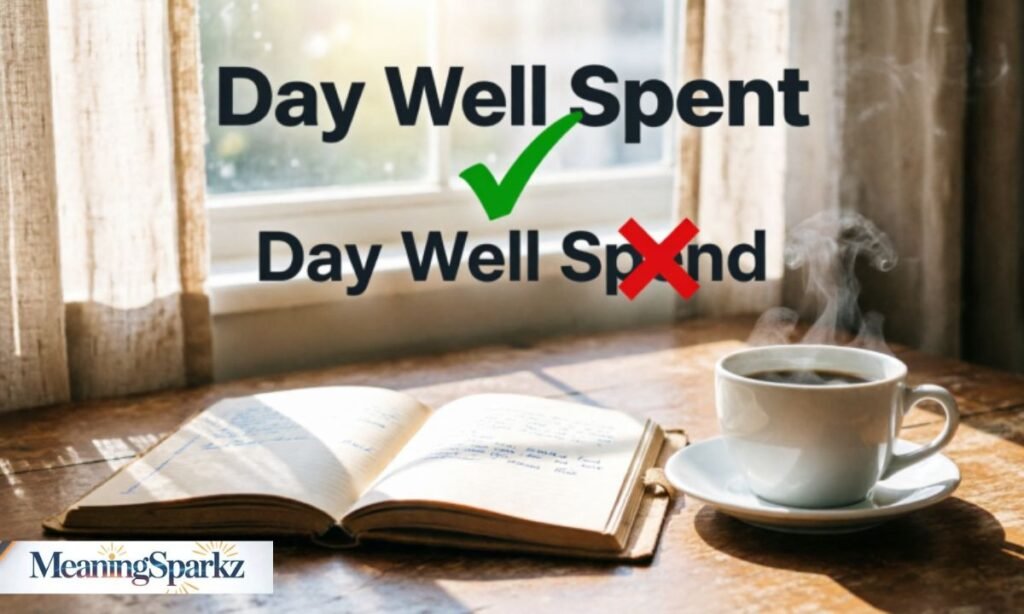
This is a grammar mix-up worth clarifying directly, because “spend” and “spent” get confused often.
- “Spend” is the base (present tense) form of the verb: “I spend my weekends hiking.”
- “Spent” is the past tense and past participle form: “I spent my weekend hiking.” / “The weekend was well spent.”
Since “day well spent” describes something that already happened a day that has been used in a certain way the correct form is always “spent,” never “spend.”
- ❌ “A day well spend” incorrect
- ✅ “A day well spent” correct
A simple way to remember it: if you can rephrase the sentence with “was” (“the day was well spent”), you need the past participle “spent,” not the base verb “spend.”
Frequently Asked Questions
Is it correct to say a day well spent?
Yes. It’s a grammatically correct, commonly used idiomatic phrase meaning a day that felt worthwhile or satisfying.
What is meant by “day well spent”?
It means a day where your time feels meaningfully used through productivity, connection, rest, or joy leaving you feeling content rather than regretful.
How do you say a day well spent?
You can say it directly, or use alternatives like “a day worth remembering,” “time well used,” or “a fulfilling day,” depending on tone.
Is the rest of the day well spent using correct grammar?
Not quite the correct phrasing is “a rest day well spent” or “my rest day was well spent,” since “well spent” needs to modify a noun like “day,” not stand alone as “rest day well spent” without an article.
Final Thoughts
“A day well spent” isn’t just correct English, it’s a genuinely useful phrase because it captures something we all chase: the feeling that our time mattered. Whether you’re writing an Instagram caption, journaling before bed, or simply reflecting on how your Sunday went, this phrase (and its many alternatives) gives you a simple, honest way to mark that feeling.
Yes, it’s become a bit of a cliché through overuse in captions and quote graphics. But clichés earn their status by being true and there’s nothing wrong with reaching for a phrase that says exactly what you mean, especially when you now have a dozen fresh ways to say it too.
However you phrase it, the goal is the same: notice the good in your day, however small, and let that be enough.
