

You’re typing a calendar invite, an appointment confirmation, or a line of website copy, and your cursor just hovers there. Two words? One word? A hyphen? It looks like such a small thing, yet it’s the kind of detail that quietly signals whether your writing is polished or careless.
Here’s the short version before we go deep: “time slot” (two words) is the grammatically correct, dictionary-recognized form. “Timeslot” shows up constantly online, but it’s still an informal variant, not a standard spelling.
By the end of this guide, you’ll know exactly why and you’ll never second-guess that space bar again.
Quick Reference Guide
| Form | Status | Where You’ll See It | Recommended Use |
| Time slot | Standard, dictionary-approved | Books, news, academic writing, business emails | Always safe |
| Timeslot | Informal, not dictionary-standard | Apps, UI buttons, casual chats, some software docs | Avoid in formal writing |
| Time-slot | Situational | Before a noun, as a modifier (e.g., “time-slot booking”) | Only when modifying another noun |
If you remember nothing else from this article, remember this: when in doubt, add the space.
What’s the Difference Between Time Slot and Timeslot?
Both versions point to the same idea: a specific, defined period set aside for something, like a meeting, a delivery, or a TV programme. The meaning never changes. What changes is the spelling style, and that’s really a question of how English compound words behave.
Grammarians classify compound nouns into three stages:
- Open compounds two separate words (time slot, ice cream)
- Hyphenated compounds joined with a hyphen, usually as modifiers (time-slot booking)
- Closed compounds fully merged into one word (email, notebook, website)
“Time slot” currently sits firmly in the open-compound stage. Words like “email” and “website” made the full journey from two words to one because decades of consistent, high-frequency use pushed dictionaries to accept the merger. “Timeslot” hasn’t reached that point yet. It’s used often, especially in digital spaces, but frequency alone doesn’t equal correctness.
So the real difference isn’t meaning it’s formality. “Time slot” belongs in polished, professional, and academic writing. “Timeslot” is the shortcut version people reach for when speed matters more than style.
Timeslot Merriam-Webster
If you search Merriam-Webster, Cambridge Dictionary, or Oxford Learner’s Dictionaries for “timeslot,” you won’t find it listed as its own headword.
What you will find is the two-word entry: time slot, defined along the lines of a period of time set aside for a specific purpose or event, such as a broadcast, appointment, or activity.
This matters because dictionaries are the closest thing English has to an official rulebook. When a major dictionary doesn’t recognize a spelling, that spelling hasn’t crossed into “standard” territory no matter how often you see it in an app or on social media.
Style authorities such as the AP Stylebook and the Chicago Manual of Style follow the same pattern, favoring the open, two-word form.
That doesn’t mean “timeslot” is meaningless or wrong to use casually. It simply means that if you’re citing a dictionary-backed spelling for a résumé, a report, or a client email, “time slot” is the one that will hold up to scrutiny.
Click Here To See More…
The Standard Two-Word Form
Two words is the safe, professional, always-correct choice. Here’s why it has staying power:
- Dictionary backing: Merriam-Webster, Cambridge, and Oxford all list only the two-word form.
- Style guide consensus: Major editorial standards (AP, Chicago) prefer open compounds unless usage overwhelmingly justifies closing them.
- Consistency with related terms: English tends to keep “time + noun” combinations open, think time frame, time zone, and time period. “Time slot” simply follows the same pattern.
- Professional expectation: Editors, teachers, and hiring managers are trained to notice small inconsistencies like this one, and the two-word form is what they expect to see.
A simple way to remember it: picture an old punch-clock with a physical slot where a card gets inserted. The “time” and the “slot” are two distinct, separate things so they stay as two separate words.
When One Word Appears
“Timeslot” isn’t a grammar crime, it’s a style choice that shows up mostly where space and speed matter more than formality. You’ll commonly spot it in:
- Mobile app buttons and UI labels, where character space is limited (“Book Timeslot” fits more comfortably than “Book Time Slot”)
- Casual texts, Slack messages, and social posts, where brevity feels natural
- Some software documentation, where developers treat it as a single variable-style term
- Marketing copy aiming for a modern, compact feel
None of this makes “timeslot” incorrect in casual settings but it also doesn’t make it dictionary-approved. Treat it the way you’d treat other digital shorthand: fine in an informal context, risky in a formal one.
Time Slot Plural
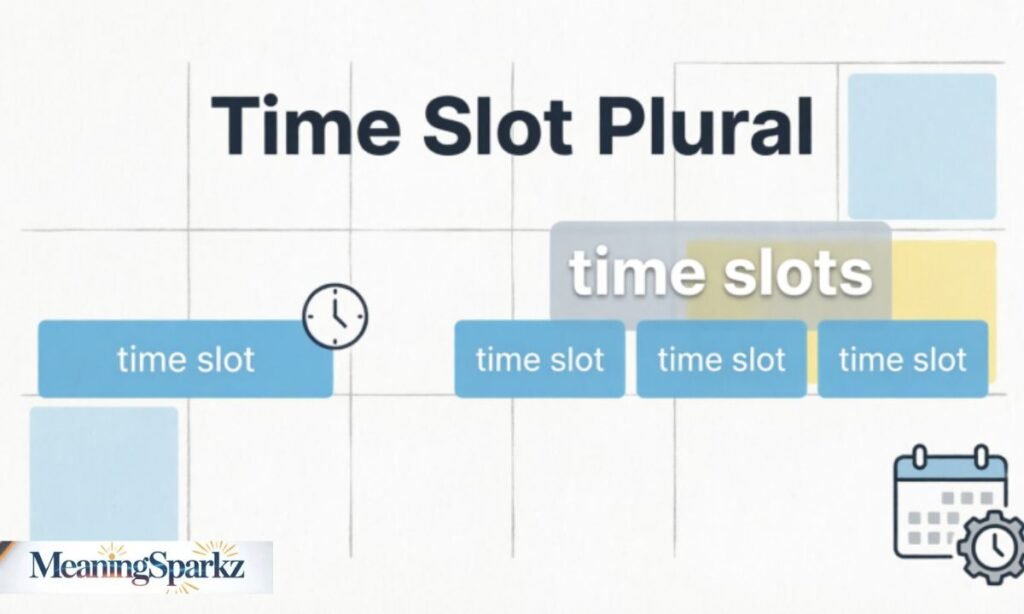
Pluralizing “time slot” is refreshingly simple just add an -s to the second word, because “slot” is the noun being counted, not “time.”
| Singular | Plural |
| time slot | time slots |
| timeslot | timeslots |
Examples:
- “The clinic has three time slots open on Friday afternoon.”
- “Choose one of the available time slots for your delivery.”
- “The website displays all open timeslots for the webinar.” (informal usage)
There’s no irregular pluralization to worry about here, and no apostrophe needed “time slot’s” would incorrectly suggest possession, not plurality.
How to Use Time Slot Correctly in Different Contexts
Getting the spelling right is only half the job. Using “time slot” naturally, in the right grammatical position, matters just as much for clean, professional writing.
As a plain noun (no hyphen needed):
- “Please select a time slot for your consultation.”
- “The 9 a.m. time slot is already booked.”
As a compound modifier before another noun (hyphenate):
- “Our time-slot booking system updates in real time.”
- “The team reviewed the time-slot allocation for next week.”
In formal documents, reports, and academic writing: Always use the two-word, non-hyphenated form unless it’s directly modifying another noun. Consistency throughout a single document matters, pick one form and stick with it from start to finish.
Time Slot Usage Across Contexts
| Context | Example Sentence | Preferred Form |
| Healthcare scheduling | “The dentist has a time slot open at 2 p.m.” | Time slot |
| Broadcasting/TV | “The show was moved to a prime-time time slot.” | Time slot |
| Business meetings | “Reserve a time slot for the quarterly review.” | Time slot |
| Online booking platforms | “Select your preferred timeslot at checkout.” | Either (context-dependent) |
| App/UI design | “Tap to choose a timeslot.” | Timeslot (space-saving) |
| Academic/legal writing | “Each candidate received a 15-minute time slot.” | Time slot |
The pattern is consistent: the more formal or permanent the writing, the stronger the case for the two-word version.
Timeslot or Time Slot UK
British and American English don’t disagree much here; both lean toward the open, two-word form. Oxford Learner’s Dictionaries, a primary reference for UK English, lists only “time slot.” That said, UK digital and broadcast contexts (much like their US counterparts) occasionally favor “timeslot” for brevity, particularly in television scheduling guides and app interfaces.
So regardless of which side of the Atlantic you’re writing for:
- Formal UK writing → time slot
- Formal US writing → time slot
- Casual/digital UK or US writing → timeslot is tolerated, but not required
There isn’t a meaningful regional split that changes the grammar rule. The two-word form remains the internationally safer bet.
Time Slot Synonyms and Related Term
Sometimes the cleanest fix for repetitive writing isn’t worrying about spelling at all, it’s swapping in a synonym. Depending on your context, consider:
- Time block often used in productivity and calendar-management writing
- Appointment slot common in healthcare and service industries
- Time window useful when flexibility exists within a range
- Scheduled period a more formal, neutral alternative
- Booking slot frequent in hospitality and reservation systems
- Time frame broader, often used when exact start/end times aren’t fixed
Choosing the right synonym depends on tone and precision. “Time window” suggests some flexibility, while “time slot” and “appointment slot” imply a fixed, specific period.
Varying your word choice can also help your writing read more naturally instead of repeating the same phrase over and over a small win for both readability and SEO.
Frequently Asked Questions
Is “time slot” one word or two?
“Time slot” is two words. This is the form recognized by major dictionaries and style guides.
Is “timeslot” grammatically wrong?
It’s not “wrong” in casual use, but it isn’t standard dictionaries and formal style guides don’t recognize it as the correct spelling.
When should I hyphenate “time-slot”?
Hyphenate only when it directly modifies another noun, such as “time-slot scheduling” or “time-slot booking.”
What is the plural of “time slot”?
The plural is “time slots” ; only the second word takes the -s.
Does Merriam-Webster list “timeslot” as a word?
No. Merriam-Webster and other major dictionaries list only the two-word form, “time slot.”
Is “time slot” different in British and American English?
Not meaningfully. Both varieties of English prefer the two-word form in formal writing.
Can I use “timeslot” in professional emails?
It’s better to use “time slot” in professional or business communication to maintain a polished, standard tone.
Will “timeslot” ever become the accepted standard spelling?
Possibly, over time, the way “email” replaced “e-mail” but as of now, there’s no dictionary or style-guide evidence that shift has happened.
Final Verdict
When you strip away the debate, the answer is refreshingly simple. “Time slot” is the correct, dictionary-backed, professionally accepted spelling. “Timeslot“ isn’t a grammar sin, it’s just a casual shortcut that thrives in apps, texts, and interfaces where space is tight and tone is relaxed.
If you’re writing a report, an email to a client, a résumé, or anything meant to look polished, go with two words: time slot. If you’re designing a mobile button or dashing off a quick message to a coworker, “timeslot” won’t raise many eyebrows.
Language keeps evolving, and it’s entirely possible “timeslot” eventually earns its place in the dictionary the way “email” and “website” once did. Until that day comes, though, the space between “time” and “slot” is doing exactly what good grammar is supposed to do: making your writing clear, consistent, and instantly credible.
