

The influencer’s results photo looks great. Glowing skin, soft morning light, your serum on the bathroom shelf. It’s already in the paid campaign deck when someone in the comments points out that the bottle’s label is subtly wrong and the “before” shot has six fingers on one hand.
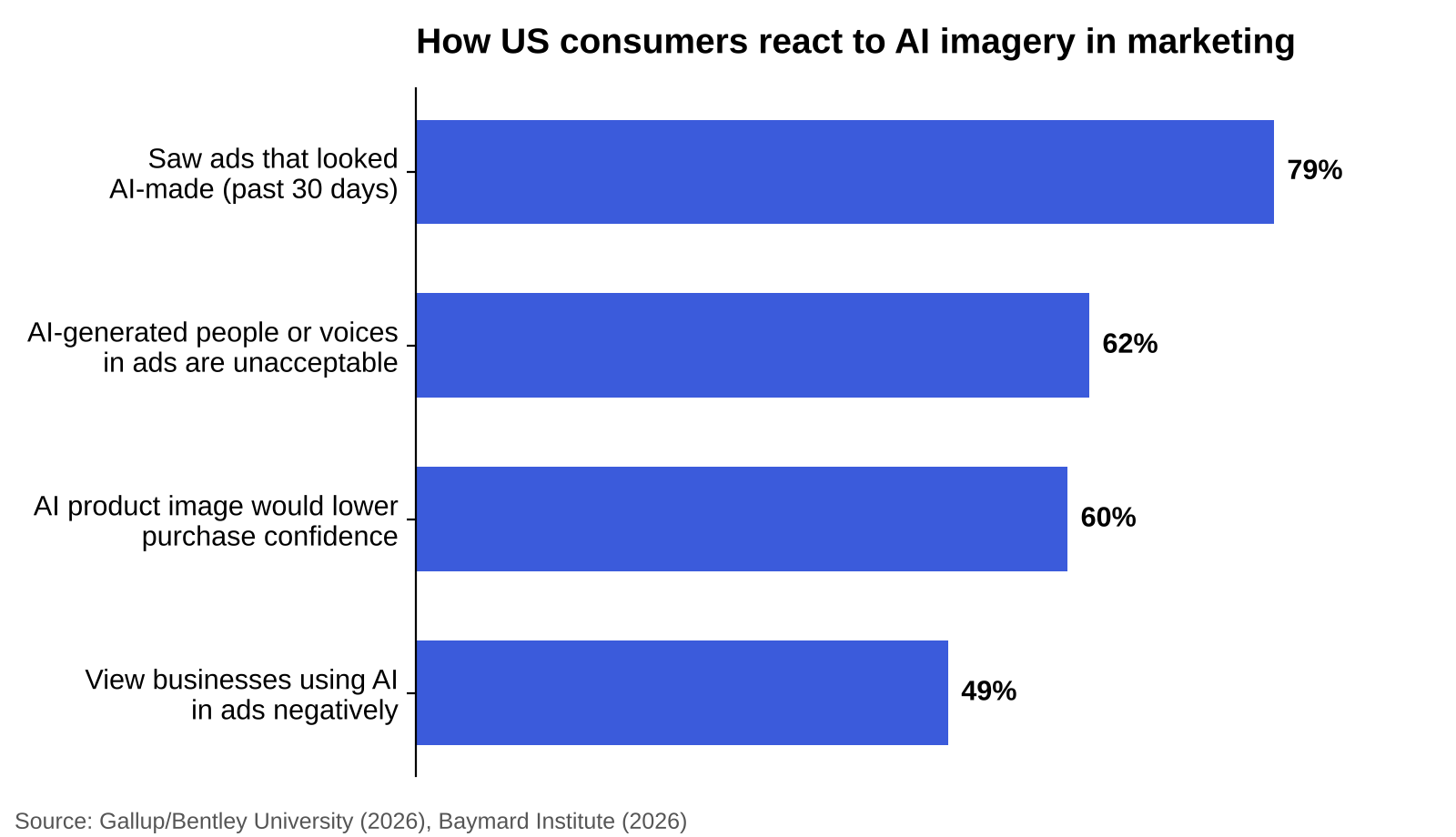
That’s the new brand risk. Not just using AI imagery yourself, but publishing someone else’s AI imagery as if it were real. Consumers are paying attention. In a Gallup and Bentley University survey of 3,270 US adults conducted in May 2026, 79% said they’d seen ads in the past month that looked like they were made with AI, and 49% viewed businesses’ use of AI in advertising negatively.
So before an image carries your logo, it’s worth knowing where it came from.
Build a Verification Step Into Your Content Workflow
Most marketing teams already have approval steps for copy, legal claims, and brand guidelines. Image provenance deserves a slot in that same chain, especially for anything you didn’t shoot yourself.
The easiest place to start is Phrasly’s free AI Image Detector. Drop in an influencer submission, a UGC photo, a contest entry, or an image from a supplier, and it returns a verdict, a confidence score, and a heatmap of where the AI is. It accepts JPG, PNG, WebP, HEIC, AVIF, and GIF files up to 20 MB, with no sign-up, and the page says images are never stored. It also checks the file for SynthID watermarks and other AI signatures.
The heatmap matters more than the headline verdict for marketing work. A lot of content isn’t fully generated. It’s a real product photo on an AI background, a retouched face, or an extended scene. Knowing which part is synthetic tells you whether the image is fine with a disclosure or misleading enough to reject.
What Consumers Actually Think About AI Imagery
@@IMG@@
How US consumers respond to AI imagery in advertising and ecommerce. Sources: Gallup and Bentley University, 2026; Baymard Institute, 2026.
The data points in one direction. In the Gallup survey, 62% said creating people or voices with AI in ads is unacceptable even when it’s disclosed. Final images, text, or video made with AI were more tolerated, with 53% finding them acceptable.
Ecommerce shoppers feel the same about product photos. Baymard Institute’s 2026 research with 2,273 US online shoppers found 60% said knowing a product image was AI-generated would lower their confidence in buying, and 17% said they wouldn’t buy at all.
There’s also a perception gap inside the industry. The IAB’s AI Transparency and Disclosure Framework, published in August 2026, cites research showing 82% of advertisers believe consumers feel positive about AI ads, while only 45% of Gen Z and Millennial consumers actually do.
Suspicion alone costs you
Consumers don’t need proof to lose trust. Raptive’s 2025 research with 3,000 US adults found content people merely suspected was AI-made was rated 48% less trustworthy. That’s why an unchecked image can hurt even when it turns out to be real.
Four Places AI Images Sneak Into Brand Content
Influencer and Creator Posts
Creators face pressure to deliver flawless results shots. Some now use AI to perfect skin, swap backgrounds, or fake “before and after” comparisons. If you repost or boost that content, the claim becomes yours.
User-Generated Content and Reviews
Customer photos are powerful precisely because they feel unpolished and real. AI-faked UGC undermines that, and the FTC’s 2024 rule on fake reviews explicitly bans reviews from someone who doesn’t exist, including AI-generated fake reviews.
Contests and Campaigns
Photo contests attract AI entries, sometimes winning ones. Checking finalists before announcing them saves an awkward public reversal.
Brand Impersonation
Scammers use AI images to build convincing fake stores, fake promotions, and fake “official” accounts. The FTC said in April 2026 that nearly 30% of people who lost money to scams in 2025 said it started on social media, with some ads leading to sites impersonating well-known brands. Separately, the FTC reported nearly $1 billion lost to business impersonators in 2025.
Disclosure Rules Are Tightening
Even when AI imagery is legitimate, you may need to label it.
- EU AI Act: Article 50’s deepfake disclosure obligations apply from August 2, 2026, with fines of up to €15 million or 3% of global turnover, according to law firm Lewis Silkin. The rules can reach non-EU brands advertising to EU audiences.
- Google Ads: Since July 2026, advertisers can add AI labels directly inside image and video ads.
- Meta: Content with detectable AI signals is labeled “AI content” on its platforms.
- IAB framework: Prompt-generated images need a label, while routine retouching or real products on AI backgrounds generally don’t, unless the result misleads.
Disclosure has a cost, so get the image right
The IAB framework cites an NYU Stern study that found disclosing AI cut click-through rates by 31.5%. That’s a reason to be deliberate about where you use AI imagery, not a reason to hide it.
A Simple Approval Checklist for Marketing Teams
|
Content type |
Check before publishing |
Decision rule |
|
Influencer results photos |
Detector scan, request originals, compare with earlier posts |
Reject if results are AI-altered |
|
UGC and reviews |
Detector scan, reverse image search |
Don’t feature unverifiable images |
|
Contest finalists |
Detector scan, ask for raw files |
Verify before announcing winners |
|
Supplier and stock imagery |
Check licence and AI disclosure terms |
Label if prompt-generated |
|
Your own AI creative |
Confirm it isn’t misleading |
Label where rules or platforms require |
Keep a simple log of what you checked and when. If a complaint or regulator question ever comes, a record showing you screened content is far better than a shrug.
Trust Is the Asset, Images Are the Proof
Marketing has always run on images, and AI hasn’t changed that. What it has changed is the assumption that a picture shows something real. Consumers are already skeptical, regulators are writing labeling rules, and scammers are borrowing brand identities with generated visuals.
The fix fits inside the workflow you already have. Scan outside images with an AI image detector, ask creators for originals, verify contest winners, and label your own AI creative where the rules call for it. A few minutes of checking keeps your brand on the right side of that skepticism, and keeps the photo in your campaign deck honest.
