

If you searched this question, you probably found a handful of scary articles. They talk about organ failure. They talk about stages and timelines. They make it sound like a real, deadly disease.
Here is the direct answer. Ozdikenosis is not a recognized medical condition. No hospital diagnoses it. No medical textbook lists it. It cannot kill you, because it is not a disease in the first place. The term appears to have started online, likely through SEO content, and spread through search results and social media before any medical body confirmed it exists.
That does not mean your symptoms are fake. It means the label is fake. Let’s break down where this term came from, what it actually might mean, and what you should do if you are dealing with real symptoms.
What Is Ozdikenosis?

Ozdikenosis is not found in any peer reviewed medical journal. It is not listed by the CDC. It is not listed by the WHO. It is not listed by any national health agency.
Different websites define it differently. That alone is a red flag. One site calls it a metabolic and nervous system syndrome. Another calls it a cellular energy disorder. A third calls it a neuromuscular inflammation condition.
Real diseases have one consistent definition. Ozdikenosis has several, and they contradict each other. That is a strong sign the term was invented for online content, not discovered in a lab or a clinic.
How Does It Start?
Articles about ozdikenosis claim it “starts quietly.” They describe fatigue, brain fog, and body aches as early signs.
Here is the problem. Those symptoms are extremely common. They show up in dozens of real conditions. Fatigue alone can point to:
- Iron deficiency
- Thyroid problems
- Sleep disorders
- Depression or anxiety
- Chronic infections
- Autoimmune disease
Claiming these common symptoms are the start of one mystery disease is misleading. It borrows real, familiar feelings and attaches them to a made up label.
The Science Behind It (In Simple Words)
There is no science behind ozdikenosis. That is the short version.
Some articles borrow language from real conditions. They mention mitochondria. They mention cellular energy. They mention organ systems working out of sync. This language sounds scientific. It is not backed by any study on ozdikenosis specifically, because no such study exists.
Real mitochondrial diseases do exist. They are rare. They are diagnosed through genetic testing and specialist evaluation. They have specific names, like MELAS or Leigh syndrome. Ozdikenosis is not one of them. It simply borrows their vocabulary to sound credible.
Which Organs Does It Hit?
Articles claim ozdikenosis affects the heart, kidneys, liver, brain, and muscles all at once. This is a common trick in fake health content. Naming many organs makes a condition sound severe and urgent.
Real multi organ conditions do exist. Sepsis is one. Certain autoimmune diseases are another. But these conditions are well documented, with clear diagnostic criteria and known causes. Ozdikenosis has none of that. No blood test confirms it. No scan detects it. No biopsy identifies it.
Why Does Ozdikenosis Kill You? A Simple Table
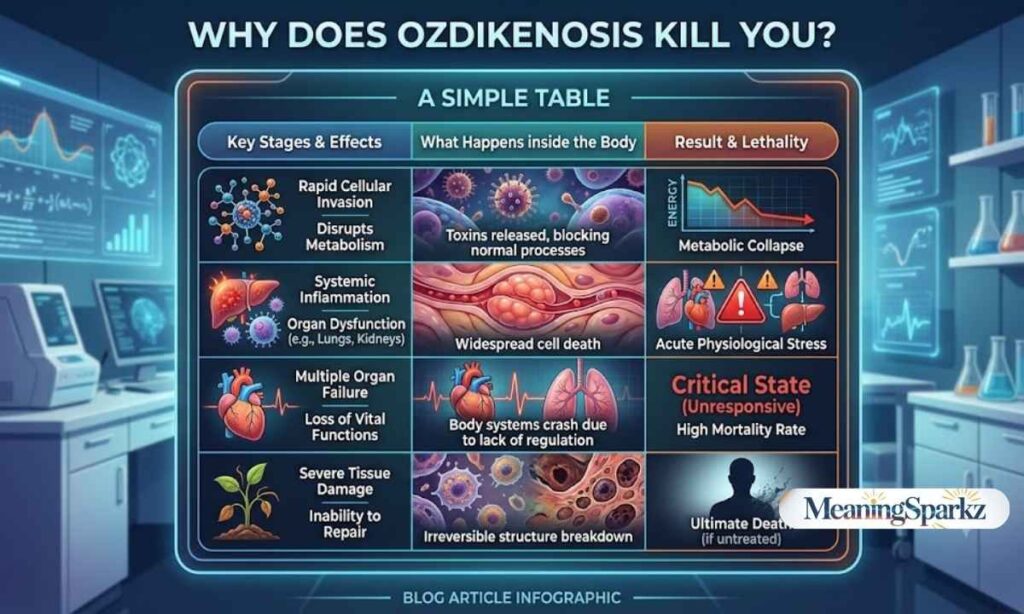
Since ozdikenosis is not a real diagnosis, it does not have a real mortality pathway. But here is a table comparing the vague claims made online with how real diseases are actually documented.
| Claim Style | Ozdikenosis Content | Real Medical Conditions |
| Diagnosis method | None given, or vague blood tests | Specific labs, imaging, biopsy, genetic testing |
| Source | Blog posts and unnamed websites | Peer reviewed journals, hospitals, health agencies |
| Definition | Changes from site to site | Consistent across all medical literature |
| Cause | Unclear or contradictory | Known mechanism, studied and published |
| Treatment | Vague lifestyle tips | Specific protocols, medications, therapies |
| Official recognition | None | Listed by WHO, CDC, or national bodies |
This table is the real answer to “why does ozdikenosis kill you.” It doesn’t, because the claims behind it don’t hold up.
The Timeline of the Disease

Some articles give a four stage timeline. Stage one is fatigue. Stage two is organ dysfunction. Stage three is organ struggle. Stage four is failure. They claim this happens within two to three years.
No source is cited for this timeline. No study tracked patients through these stages. No hospital reports diagnosing anyone with ozdikenosis, let alone tracking their progression.
A real disease timeline comes from long term studies. Researchers follow patients for years. They publish survival rates and progression data. None of that exists here. The timeline appears to be written for dramatic effect, not medical accuracy.
Why Is It So Hard to Catch Early?
Articles claim doctors miss it because it looks like chronic fatigue, lupus, or stress. This is another borrowed idea. Real conditions like lupus are genuinely hard to diagnose early. That part is true.
But applying that difficulty to ozdikenosis is misleading. Doctors do not “miss” ozdikenosis. They cannot diagnose something that has no clinical definition, no test, and no code in medical record systems. It is not that doctors overlook it. It is that there is nothing to look for.
If you feel unwell and a doctor cannot explain why right away, that is common with many real conditions. It does not confirm you have a specific undiscovered disease.
Can It Be Treated?
There is no approved treatment for ozdikenosis, because there is no confirmed disease to treat. Some sites suggest supplements, lifestyle changes, or vague “protocols.” These recommendations are not tied to any clinical trial.
If you are dealing with real symptoms like fatigue, brain fog, or muscle pain, the right move is a real medical workup. That includes bloodwork, a physical exam, and a conversation with your doctor about your full history.
Real conditions that cause these symptoms usually do have treatment options once properly diagnosed.
Click Here To Read Another Topic
Warning Signs to Watch For
Instead of watching for “ozdikenosis,” pay attention to real warning signs that need medical attention:
- Sudden or severe fatigue that does not improve with rest
- Unexplained weight loss
- Chest pain or shortness of breath
- Persistent fever
- Swelling in the legs, face, or abdomen
- Confusion or sudden changes in thinking
- Muscle weakness that gets worse over time
These symptoms are worth a doctor’s visit. They point to real, diagnosable conditions. Do not wait on a label that does not exist. Act on the symptoms themselves.
Final Thoughts
Ozdikenosis is not a real, medically recognized disease. It cannot kill you, because there is no verified condition behind the name. The term spread online through content built to look alarming and authoritative, without any backing from hospitals, journals, or health agencies.
If you feel unwell, your symptoms are real and worth taking seriously. But the right next step is a real doctor and real testing, not a search term with no medical basis. Trust your body. Question the label.
Frequently Asked Questions
What are the first signs that ozdikenosis is affecting your body?
There are no confirmed signs, because ozdikenosis is not a recognized medical condition. Fatigue, brain fog, and body aches are real symptoms, but they point to many other conditions, not a specific disease called ozdikenosis.
How fast does ozdikenosis get worse?
There is no verified timeline. Any staged progression you see online is not backed by clinical studies or patient data. Treat these timelines as unverified content, not medical fact.
Does ozdikenosis only affect older people?
No age pattern has been documented, because no clinical data on ozdikenosis exists. Claims about who it affects are not based on research.
Why do doctors often miss zidokinosis at first?
Doctors do not miss it. There is no diagnostic test, code, or clinical definition for it. If you feel unwell, doctors work from your actual symptoms and test results, not an undefined label.
Can you slow down ozdikenosis or stop it from getting worse?
There is no approved treatment, because there is no confirmed condition to treat. If you have ongoing symptoms, ask your doctor for a full evaluation. Real conditions behind common symptoms usually do have management options.
