

You typed “goodmorning” in a text, then paused. Something looked off. Was it supposed to be two words? Did autocorrect just save you or ruin you?
Here’s the short answer: “Good morning” is always two words. “Goodmorning” is not a recognized word in standard English, no matter how often you see it in texts or social captions. Once you know the simple rule behind it, you’ll never second guess it again.
The correct and standard way to write this greeting is as two separate words: good morning. “Goodmorning” is actually considered incorrect spelling in English grammar!
Why I Found It’s Written as Two Words
“Good morning” works the same way as “good afternoon” or “good evening.” “Good” is an adjective describing the noun “morning.” Two separate words, two separate jobs.
English doesn’t usually smash an adjective and a noun into one word unless it’s an established compound (like “sunrise” or “daybreak”). “Good morning” never made that jump. Dictionaries, style guides, and grammar checkers all agree: it stays split.
The Basic Rule I Follow
If you can swap the noun and the sentence still makes sense, keep the words separate. “Good morning,” “good afternoon,” “good night” (as a greeting) all follow this pattern. None of them merge into one word, and “goodmorning” is simply a typo that spread through fast typing and autocorrect habits, not a legitimate spelling variant.
Click Here To Read More Topics
Morning vs Good Morning From a Girl

This phrase shows up a lot in search bars, usually from people decoding a text message. If someone sends just “morning,” it’s casual, almost lazy in a cute way. It’s the texting equivalent of a wave.
“Good morning” carries more intention. It takes an extra half second to type, and that effort often signals warmth or genuine thoughtfulness, especially in a new relationship or flirty context. Neither version is wrong grammatically. The difference is tone, not correctness.
The “Goodnight” Confusion: Why It’s Different
Here’s where a lot of people trip up, and honestly, it’s a fair mix up. “Goodnight” is often written as one word, especially in casual writing, song titles, and text messages. So if “goodnight” can be one word, why not “goodmorning”?
The truth is messier than most grammar guides admit. “Good night” as a farewell has drifted toward being accepted as “goodnight” in informal use, largely because it functions as a fixed, standalone expression rather than a true adjective-noun pair in that context.
Important Note I Found
Even “goodnight” as one word is considered informal by most style guides, including Merriam Webster, which still lists “good night” as the primary form. “Good morning” hasn’t undergone that same informal shift. It has stayed firmly as two words across formal and informal writing alike, so treating it the same as “goodnight” is a mistake.
When and How I Use “Good Morning” Correctly
Knowing the rules is one thing. Using it naturally in different situations is where people actually get stuck. Here’s how it breaks down across common formats.
1. Email Greetings (Formal)
Start professional emails with “Good morning,” followed by a comma, then the recipient’s name on the next line, or “Good morning, [Name],” if you prefer it inline. Capitalize only “Good,” never both words.
2. Casual Text Messages
Lowercase is fine here. “good morning :)” or “good morning!” both work. Just keep the two words separate, even when everything else is relaxed.
3. Verbal Greetings
When speaking, this isn’t a spelling issue, but people often ask if it should be “good morning” or “morning” as a shortened form. Both are acceptable out loud. “Morning” alone is simply the casual, clipped version.
4. Cards and Notes
Handwritten notes often stylize the greeting with a bigger font or a decorative flourish, but the words themselves should always be written separately. Style the presentation, not the spelling.
Good Morning or Goodmorning Meaning
Both phrases attempt to communicate the same thing: a friendly wish for someone’s morning to go well. But only “good morning” is the version accepted in dictionaries, style guides, and professional writing. “Goodmorning” carries no separate meaning of its own. It’s not a new word, a slang variant, or a regional spelling. It’s simply an error that happens when two words get typed too quickly.
Common Mistakes I’ve Found and How to Avoid Them
People slip up in a few predictable ways:
- Merging the words entirely, writing “Goodmorning” as if it’s one unit
- Capitalizing both words mid sentence, like “Good Morning everyone,” when only “Good” needs the capital
- Adding an apostrophe, occasionally seen as “good mornin'” in overly casual writing, which is fine for texting but not for formal contexts
- Using it as a noun, like “I said my goodmorning,” which doesn’t work since “good morning” functions as a greeting phrase, not a standalone noun
Avoiding these takes almost no effort once you notice the pattern. It becomes automatic within a few uses.
Memory Tips I Use to Remember the Rule
If the grammar explanation didn’t fully stick, these two shortcuts will.
Memory Trick #1: The “Wishing” Method
Think of the phrase as short for “I wish you a good morning.” Nobody writes “I wish you a goodday” or “a goodafternoon.” Once you expand it mentally, keeping the words apart feels obvious.
Memory Trick #2: The Pattern Recognition
Line it up next to its siblings: good morning, good afternoon, good evening. Three greetings, same structure, always two words. “Good morning” isn’t an exception. It’s part of a consistent family.
Other Greeting Patterns I Discovered
Once you notice the “good + time of day” pattern, you’ll spot it everywhere. “Good afternoon” and “good evening” follow identical rules, always two words, always capitalized only on “Good” in formal writing.
“Good day” is a bit rarer in everyday American English but follows the same structure. The only outlier, as covered earlier, is “good night,” which has picked up informal single word usage as a farewell, unlike the others.
Real-World Examples I’ve Collected
Seeing the rule in context makes it click faster than any explanation alone.
Email Example (Professional)
“Good morning, Sarah,
I wanted to follow up on yesterday’s meeting notes…”
Text Message Example (Casual)
“Good morning! hope you slept okay ????”
Greeting Card Example
“Good Morning, Sunshine! Wishing you a bright start to your day.”
Notice how the format changes (punctuation, capitalization, tone) but the two word structure never budges.
Good Morning vs Goodmorning: My Summary Table
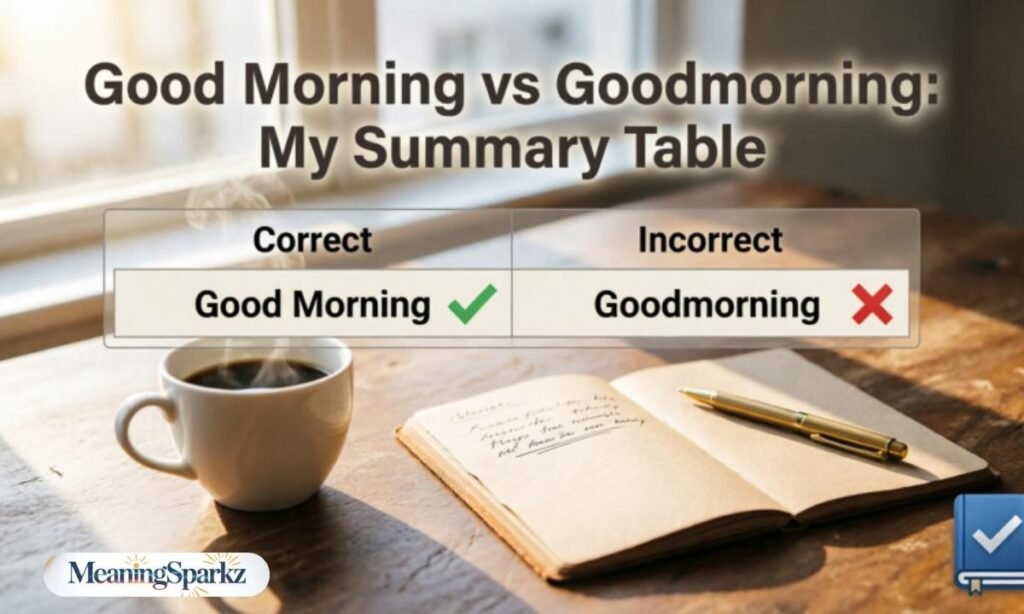
| Version | Correct? | Common Use | Notes |
| Good morning | Yes | Formal and casual | Standard, dictionary approved |
| Goodmorning | No | Typos, fast texting | Not a recognized word |
| Good Morning (mid sentence) | No | Common error | Only “Good” should be capitalized |
| good morning | Yes | Texts, casual chats | Acceptable in informal writing |
Pro Tip I Learned
If your phone’s autocorrect keeps suggesting “Goodmorning” as one word, it’s likely picking up on your own typing history, not confirming correctness. Manually correcting it a few times usually retrains it.
Explore More Grammar Guides
Curious about similar mix ups? Related phrases worth checking include “good night vs goodnight,” “good afternoon vs goodafternoon,” and “everyday vs every day,” since they all follow the same kind of compound word confusion that trips up even experienced writers.
Frequently Asked Questions
Is it spelled goodmorning or good morning?
It’s spelled “good morning,” as two separate words. “Goodmorning” is not a standard English word and won’t appear correctly in dictionaries or formal writing.
How to say good morning in a flirty way?
Add personal warmth rather than changing the spelling. Try “Good morning, gorgeous” or “Good morning, I was just thinking about you.” The flirtation comes from the added words and tone, not from altering “good morning” itself.
Is goodmorning a single word?
No. Despite frequent use in fast texting, “goodmorning” has never been adopted as a single word by any major English dictionary. It remains an informal typo, not an alternate spelling.
How does Gen Z say good morning?
Gen Z often shortens it to “morning,” “mornin’,” or uses casual variations like “gm,” especially in texting and social media comments. These are stylistic shortcuts, not replacements for the correct spelling in formal contexts.
Final Takeaway
“Good morning” is, and has always been, two words. “Goodmorning” is simply a fast typing habit that never earned dictionary status.
Once you lock in the “good + time of day” pattern, you’ll never have to pause over this one again, whether you’re writing a formal email or just texting someone a warm good morning.
