

Have you ever typed a quick email or text, stared at the word “openned,” and felt something was off? You’re not imagining things. This is one of the most common spelling slip-ups in English, and it trips up native speakers and learners alike. The confusion makes sense once you know why it happens but the fix is refreshingly simple.
This guide breaks down the correct spelling, the grammar rule behind it, real sentence examples across different writing styles, and answers to the questions people actually search for. By the end, you’ll never second-guess this word again.
Quick Answer
Opened is the correct spelling. Openned is a misspelling and does not exist in standard English, in any dictionary, or in any variety of English (American, British, Australian, or otherwise).
The rule is short: open + ed = opened. No double “n,” no exceptions, no regional variation.
Meaning of “Opened”
“Opened” is the past tense and past participle of the verb open. It describes an action that has already happened, and it generally carries one of these meanings:
- To move something (a door, window, box, or lid) so it’s no longer closed
- To make something available or accessible for the first time
- To begin or start an event, meeting, or activity
- To unfold, unfasten, or unlock something
Examples:
- She opened the door and stepped inside.
- The bakery opened a new branch downtown.
- He opened his laptop and checked his messages.
- The ceremony opened with a short speech.
Notice that in every case, “opened” refers to something that has already taken place; it’s a completed action, not something happening right now.
The Store Is Open or Opened
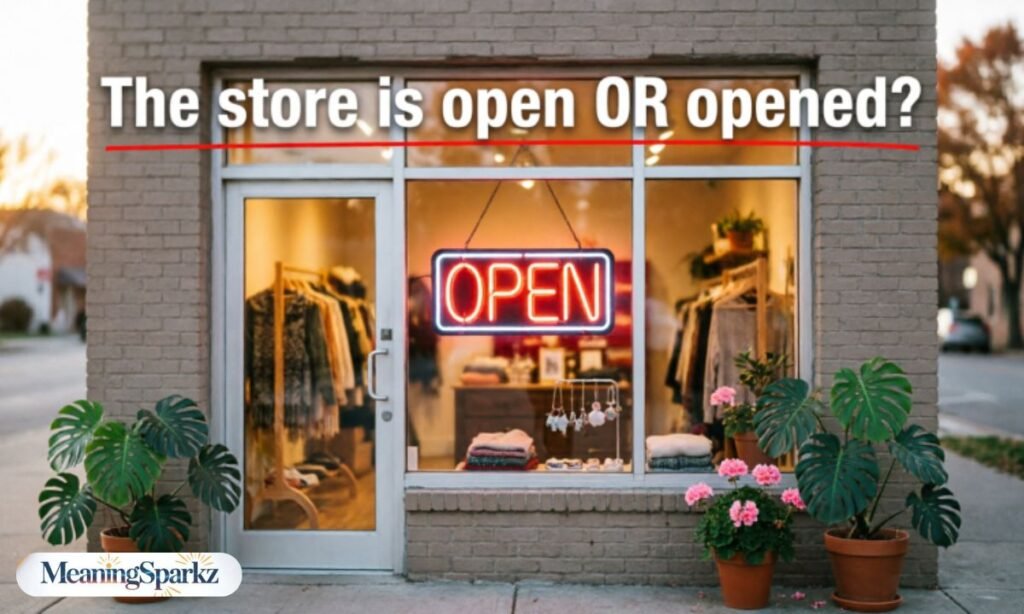
This is a classic mix-up because “open” and “opened” can both follow “is,” but they mean different things.
- “The store is open” uses open as an adjective. It describes the current state: the store is currently available for business, right now.
- “The store is opened” is used opened as part of a passive verb construction. It usually implies someone opens the store as a repeated or specific action, such as “The store is opened by the manager every morning.”
For everyday use, “The store is open” is what you want when describing whether a business is currently operating. “The store opened” (simple past tense) is correct when talking about when it started operating, such as “The store opened at 9 a.m.”
| Phrase | Function | Example |
| The store is open | Adjective (current state) | The store is open until 8 PM. |
| The store opened | Past tense verb (event) | The store opened an hour ago. |
| The store is opened | Passive voice (action done by someone) | The store is opened by staff at dawn. |
Click Here To Read More…
Why People Mistakenly Write “Openned”
If “opened” is so straightforward, why does the double-“n” version show up so often? A few real reasons explain it:
- Pattern confusion with other verbs. Words like stop → stopped, plan → planned, and shop → shopped double their final consonant before adding “-ed.” Since “open” also ends in “n,” people assume it follows the same pattern.
- Pronunciation habits. Some speakers stress the word in a way that makes “open-ned” sound plausible in their head, even though it isn’t how the word is pronounced.
- Fast typing and autocorrect gaps. On phones and in chat apps, autocorrect doesn’t always catch this error, especially in informal writing.
- Lack of awareness of the stress rule. Most people were never explicitly taught why some verbs double letters and others don’t so they guess.
Understanding the actual rule clears up the confusion instantly, which brings us to the next section.
Simple Rule to Remember
English has a well-defined rule for whether a final consonant gets doubled before adding “-ed”:
Double the final consonant only when the stress falls on the last syllable of the word.
Say the word “open” out loud: OH-pen. The stress lands on the first syllable, not the last. Because of that, the final “n” is not doubled.
Compare this to a word like “prefer” (pre-FER), where the stress is on the last syllable that’s why it becomes “preferred” with a doubled “r.”
Quick memory trick: Open doesn’t need extra letters to open. One “n” is all it takes just like it happened, listened, and visited, which follow the exact same stress pattern.
Comparison Table: Openned vs Opened
| Feature | Opened ✅ | Openned ❌ |
| Dictionary status | Recognized standard word | Not a real word |
| Grammar rule | Follows regular -ed pattern | Incorrectly doubles the “n” |
| Used in American English | Yes | No |
| Used in British English | Yes | No |
| Appears in formal writing | Yes | Never |
| Common in typos/autocorrect misses | No | Yes |
| Passes spell-check | Yes | Usually flagged |
Examples in Sentences
Seeing “opened” used correctly across different contexts makes the rule easier to internalize. Here’s how it fits naturally into everyday, professional, academic, and digital writing.
Daily Conversation
- I opened the fridge and grabbed a snack.
- She opened the window because it was hot.
- We opened our presents on Christmas morning.
- He opened the car door for his grandmother.
Professional Writing
- The company opened its third regional office this quarter.
- Management opened the floor for questions after the presentation.
- The bank opened a new line of credit for the client.
- Our team opened negotiations with the vendor last week.
Academic Writing
- The researcher opened the discussion by outlining the study’s limitations.
- The essay opened with a compelling statistic about climate change.
- Historians note that the treaty opened a new era of diplomacy.
- The lecture opened with a review of prior findings.
Digital Communication
- I opened your message but haven’t replied yet.
- The app opened a pop-up asking for permissions.
- She opened the shared document and left a comment.
- The link opened in a new browser tab.
Why Opened Not Openned

The short version: English spelling doubles a final consonant only when doing so reflects how the word is actually stressed and pronounced. “Open” simply doesn’t meet that condition.
Here’s the logic laid out step by step:
- The base verb is open.
- Stress falls on the first syllable: O-pen.
- Because the stress isn’t on the final syllable, the consonant-doubling rule doesn’t apply.
- Add the standard “-ed” ending: open + ed = opened.
- No letter is doubled, and none needs to be.
This is the same reason we write, listen, visit, and enter. All these verbs have first-syllable stress, so they take a plain “-ed” without doubling.
Common Mistakes to Avoid
- ❌ I openned the box carefully. → ✅ I opened the box carefully.
- ❌ The meeting openned late. → ✅ The meeting opened late.
- ❌ She openned her own bakery. → ✅ She opened her own bakery.
- ❌ Assuming every verb ending in “n” doubles that letter before “-ed” (it doesn’t this only applies to words with last-syllable stress).
- ❌ Trusting autocorrect blindly, especially in messaging apps where it sometimes misses this error.
- ❌ Confusing “open” (adjective, current state) with “opened” (verb, completed action) remember, “the door is open” describes a state, while “the door opened” describes an event.
American vs British English Differences
Good news here: there’s no split at all. Unlike words such as colour/color or travelled/traveled, where American and British English genuinely diverge, “opened” is spelled identically everywhere English is written.
| Region | Correct Spelling |
| American English | opened |
| British English | opened |
| Australian English | opened |
| Canadian English | opened |
You never need to adjust this word based on your audience’s location; it’s universally consistent.
Related Forms of “Open”
Since “open” is a regular verb, all its forms follow predictable, single-“n” spelling:
| Form | Word | Example |
| Base form | open | I open the store every day. |
| Present tense (3rd person) | opens | She opens the shop at 9 AM. |
| Past tense | opened | He opened it yesterday. |
| Past participle | opened | The box has been opened. |
| Present participle | opening | They are opening a new branch. |
| Adjective | open | The window is open. |
Note that “opening” (present participle/gerund) also keeps a single “n” the same stress rule applies there too.
Synonyms for “Opened”
Using synonyms can add variety to your writing and avoid repetition. Depending on context, you can swap “opened” for:
- Unlocked – He unlocked the door before stepping in.
- Unfastened – She unfastened the latch on the gate.
- Launched – The company launched its new product line.
- Began / Started – The ceremony began with a welcome address.
- Revealed – The curtain revealed the stage setup.
- Inaugurated – The mayor inaugurated the new library.
- Unveiled – They unveiled the exhibit to the public.
Choose the synonym that matches your tone “launched” and “inaugurated” suit formal or business writing, while “unlocked” and “started” work well in casual contexts.
Openned or Opened Grammar
From a pure grammar standpoint, “opened” plays two roles:
- Simple past tense describing a completed action. She opened the letter.
- Past participles used with helping verbs like “has,” “have,” or “had,” or in passive constructions. The store has opened. The gift was opened.
“Openned” has no grammatical role because it isn’t a recognized word in any English dictionary, style guide, or grammar reference. If you see it in writing, it should always be corrected to “opened.”
Mini Spelling Test (Try Yourself)
Test what you’ve learned. Choose the correct spelling in each sentence:
- She ___ the window this morning. (opened / openned)
- The shop ___ its doors at 10 AM. (opened / openned)
- He ___ the email and replied instantly. (opened / openned)
- They ___ a new restaurant last month. (opened / openned)
- The book ___ to the exact page she needed. (opened / openned)
Answer key: All five correct answers are opened. If you got them all right, you’ve mastered the rule!
Why Correct Spelling Matters
A single misspelled word might seem minor, but it can affect how your writing is perceived:
- Professionalism: Errors like “openned” can make emails, resumes, and reports look rushed or careless.
- Credibility: Readers often equate correct spelling with attention to detail and reliability.
- Clarity: Consistent spelling helps readers process your message without stumbling over unfamiliar or incorrect word forms.
- SEO and searchability: Content with accurate spelling performs better in search results and builds trust with readers and search engines alike.
Small details like this add up, especially in academic submissions, job applications, and professional correspondence where first impressions matter.
Frequently Asked Questions
Which is correct, opened or openned?
“Opened” is the correct spelling. “Openned” is a common misspelling and isn’t recognized in standard English.
What is the past tense of open?
The past tense of “open” is “opened,” formed by simply adding “-ed” without doubling the final letter.
Why not openned?
Because the stress in “open” falls on the first syllable, English doesn’t double the final consonant before adding “-ed.”
Which spelling is correct, openning or opening?
“Opening” is correct. Like “opened,” it keeps a single “n” because of the same first-syllable stress pattern.
Summary
The confusion between “openned” and “opened” comes down to a simple, well-defined spelling rule: consonants only double before “-ed” when the stress falls on the final syllable of the word. Since “open” is stressed on its first syllable, it never doubles its final “n” making opened the only correct spelling in American, British, and all other varieties of English.
Whether you’re writing a text message, a business report, or an academic paper, remembering this one rule that doesn’t need extra letters to open will keep your writing accurate and polished every time.
