

If you’ve ever typed this word into an email, an ad campaign, or a school essay and then stared at it wondering if it looks right, you’re in good company. It’s one of the most commonly misspelled words in business and marketing writing, and the confusion makes sense once you understand why it happens.
This guide settles the question for good, explains the grammar rule behind it, and gives you a memory trick so you never second-guess yourself again.
Quick Answer:
Targeted is the only correct spelling. Targetted, with a double “t,” is a misspelling and doesn’t appear in any major dictionary American, British, Canadian, or Australian. The word comes from the noun target, and you simply add “-ed” to form the past tense: target + ed = targeted. No doubling required.
Meaning of “Targeted”

“Targeted” is the past tense and past participle of the verb target, meaning to aim at, focus on, or direct something toward a specific person, group, or objective. It also works as an adjective describing something that has been specifically chosen or aimed at.
A few common ways the word is used:
- As a verb: The company targeted new customers with a fresh campaign.
- As an adjective: They launched a targeted advertising strategy.
- In a general sense: describing precision, focus, or intent rather than something broad or random.
The word shows up constantly in marketing, healthcare, cybersecurity, politics, and everyday communication, which is exactly why getting the spelling right matters so much.
Beyond its literal meaning, “targeted” carries a connotation of precision and intent. When something is described as targeted, it implies a deliberate strategy rather than a scattershot or random effort.
A “targeted email campaign” reaches specific subscribers based on behavior or interest, while an untargeted campaign might blast the same message to everyone regardless of relevance. That distinction between broad and focused effort is a big part of why the word has become so common in professional and digital contexts; it signals efficiency, strategy, and intentional decision-making, all in a single word.
The word can also function in more technical or specialized ways. In medicine, “targeted therapy” refers to treatments designed to interact with specific molecules involved in the growth of cancer cells, as opposed to traditional treatments that affect the whole body.
In cybersecurity, a “targeted attack” refers to an operation aimed at a specific organization or individual rather than a broad, random attempt. In each of these fields, precision is the whole point and the word “targeted” captures that idea concisely.
Click Here To Read More…
Targetted or targeted british spelling
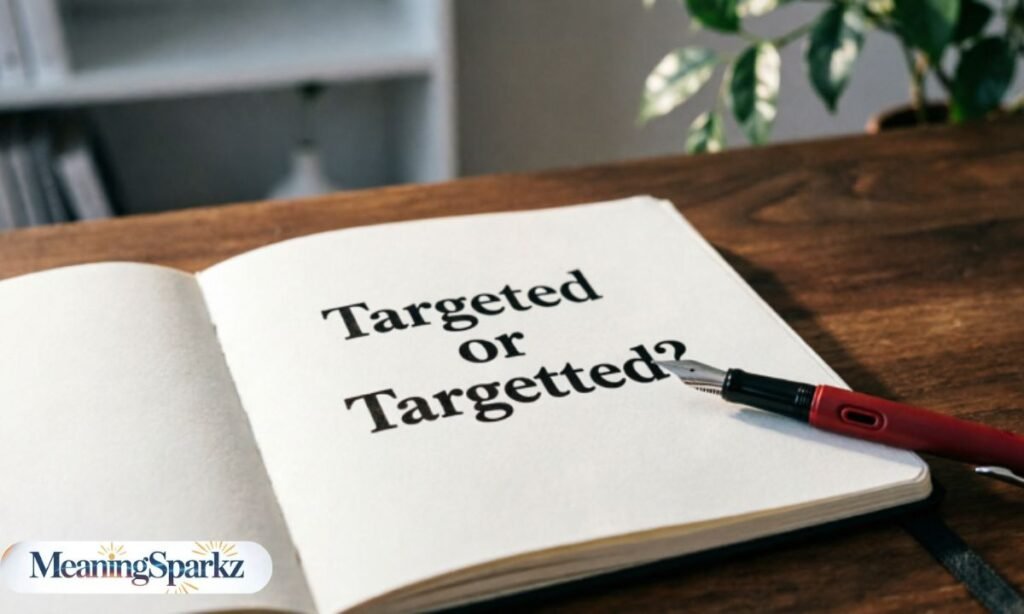
A lot of people assume British English might allow the double-“t” version, the same way it keeps the “u” in colour or doubles the “l” in travelling. That assumption is wrong here. British English, like American English, uses targeted with a single “t.”
There’s no regional variant that accepts “targetted” as standard. Whether you’re writing for a UK, US, Canadian, or Australian audience, the spelling doesn’t change a rare case of full agreement across English dialects.
Why “Targetted” Is Incorrect
The mix-up isn’t random. English does double the final consonant in some words when adding “-ing” or “-ed” think stop → stopped or commit → committed. So it’s a reasonable (but wrong) guess to assume the target follows the same pattern.
Here’s the actual rule: consonant doubling happens when the final syllable of a word is stressed and ends in a single vowel followed by a single consonant. In target, the stress falls on the first syllable TAR-get, not tar-GET. Because the stress isn’t on the final syllable, the consonant doesn’t double. That’s the whole explanation in a nutshell.
Compare it to similar words:
- Visit → visited (stress on first syllable, no doubling)
- Enter → entered (stress on first syllable, no doubling)
- Prefer → preferred (stress on final syllable, doubling occurs)
- Regret → regretted (stress on final syllable, doubling occurs)
Target behaves like visit and enter, not like regret or prefer. That’s the pattern your ear can learn to catch.
Simple Rule to Remember
You only double the final consonant before adding “-ed” or “-ing” when both of these are true:
- The stress falls on the last syllable of the word.
- That syllable ends in a single vowel followed by a single consonant.
Since target is stressed on the first syllable, neither condition applies past that first check, and the consonant stays single. Whenever you’re unsure about a word like this, try saying it out loud and listening for where the emphasis lands. That alone often tells you what to do.
Targeted vs Targetted Comparison Table
| Feature | Targeted ✅ | Targetted ❌ |
| Dictionary status | Recognized in all major dictionaries | Not recognized anywhere |
| American English | Correct | Incorrect |
| British English | Correct | Incorrect |
| Spelling rule followed | Yes (no doubling, stress on first syllable) | No (misapplies doubling rule) |
| Used in formal/academic writing | Yes | Never |
| Recognized by spell-checkers | Yes | Flagged as an error |
| Common in casual typos | Rare | Frequent |
American vs British English Differences
English has plenty of words that genuinely change spelling depending on region color/colour, organize/organise, traveling/travelling. “Targeted” isn’t one of them. Both American and British English use the exact same single-“t” spelling. There’s no need to switch versions depending on your audience’s location, which actually makes this one easier than most spelling questions involving US vs UK English.
The only minor difference between the two dialects is pronunciation, not spelling:
- US English: /ˈtɑːrɡɪtɪd/
- UK English: /ˈtɑːɡɪtɪd/
The “r” sound after the initial vowel is pronounced in American English and typically dropped in British English, a general feature of rhotic versus non-rhotic accents, not something specific to this word.
Common Mistakes People Make
Even experienced writers slip up here. The most frequent errors include:
- Doubling the “t” automatically because it feels similar to words like committed or regretted.
- Writing “targetting” instead of “targeting” the same doubling mistake applied to the present participle.
- Assuming British spelling doubles it, following the pattern of words like travelled or modelled.
- Typing too quickly and adding an extra letter out of habit rather than intention.
- Copying the error from something they’ve read, since the misspelling shows up often enough in informal writing and social media that it starts to look normal.
None of these reasons make the double-“t” version acceptable in professional, academic, or published writing.
There’s also a pattern worth noticing: many of these mistakes cluster around fast-paced writing environments, social media captions, quick internal emails, ad copy drafted under deadline pressure. In those situations, writers are less likely to pause and double-check a word that “looks close enough.”
That’s precisely when small, avoidable spelling errors slip into published content and start spreading, since readers who see the error repeated in enough places may start to assume it’s a valid alternative. It isn’t. Autocorrect tools and grammar checkers will typically flag “targetted” as an error, which is a good habit to lean on if you’re ever unsure mid-sentence.
It also helps to recognize which other words trip people up for the exact same reason. “Benefitted” versus “benefited” and “focussed” versus “focused” follow a nearly identical pattern to “targetted” versus “targeted” a stressed first syllable that doesn’t call for consonant doubling, despite what instinct suggests.
Once you understand the underlying stress-based rule, you can apply it to all three words (and plenty of others) instead of memorizing each one individually.
Targetted vs targeted reddit

Search around online forums like Reddit, and you’ll find this exact question pop up regularly in writing, grammar, and marketing subreddits. The consensus across those discussions lines up with every dictionary and style guide: targeted is correct, and targetted is a mistake even though it’s common enough that people frequently ask about it.
A recurring theme in these threads is that the double-“t” spelling “looks right” to a lot of native speakers because of how often similar-looking words double their consonants, which is exactly the kind of pattern-matching error grammar rules exist to correct.
If you’re relying on forum advice for spelling questions, it’s worth cross-checking against an actual dictionary but in this case, the crowd and the reference books agree completely.
Example Sentences Using “Targeted” Correctly
- The nonprofit ran a targeted campaign to reach first-time donors.
- Doctors are increasingly using targeted therapies to treat specific types of cancer.
- The ad platform lets you build a targeted audience based on interests and location.
- Analysts believe the cyberattack targeted government infrastructure.
- Her lesson plan targeted the students who were struggling most with fractions.
- The government announced targeted relief for small businesses affected by the storm.
Notice how the word works equally well in marketing, healthcare, cybersecurity, education, and public policy contexts; its versatility is part of why it’s used so often.
Synonyms and Related Words
Depending on context, these words can work as alternatives to “targeted”:
- Aimed
- Focused
- Directed
- Specific
- Selective
- Intended
- Designated
- Pinpointed
Related word forms to keep straight:
- Target (noun/verb, base form)
- Targeting (present participle one “t,” not “targetting”)
- Targets (plural noun or third-person verb form)
- Targetable (adjective, less common)
These synonyms aren’t always perfectly interchangeable. “Aimed” and “directed” tend to work well in physical or strategic contexts, while “selective” and “specific” fit better when describing an approach or method. Choosing the right synonym often comes down to tone: “pinpointed” feels more precise and technical, while “focused” feels slightly more general and conversational.
Understanding these small differences can help you vary your writing without losing meaning, especially in longer pieces where repeating “targeted” too many times can start to feel repetitive.
When Should You Use “Targeted”?
Use “targeted” whenever you’re describing something that has been specifically aimed at, focused on, or chosen for a particular purpose, rather than something general or random. It fits naturally in:
- Marketing and advertising copy (targeted ads, targeted campaigns)
- Business and strategy writing (targeted growth, targeted outreach)
- Healthcare and science (targeted treatment, targeted therapy)
- Security and defense contexts (targeted attack, targeted response)
- Education (targeted intervention, targeted feedback)
If you’re describing precision or intent instead of something broad or unfocused, “targeted” is almost always the right word choice.
A useful way to test whether “targeted” is the right word for your sentence is to ask whether you could replace it with “random” or “general” and have the meaning flip completely. If the answer is yes if the word is doing the job of signaling deliberate focus then “targeted” belongs in that sentence. For example, “a targeted survey of loyal customers” implies a specific, chosen group, while “a general survey of customers” implies no particular selection process at all.
That contrast is the core function the word performs across every field it appears in, from advertising to public health.
Targeted pronunciation
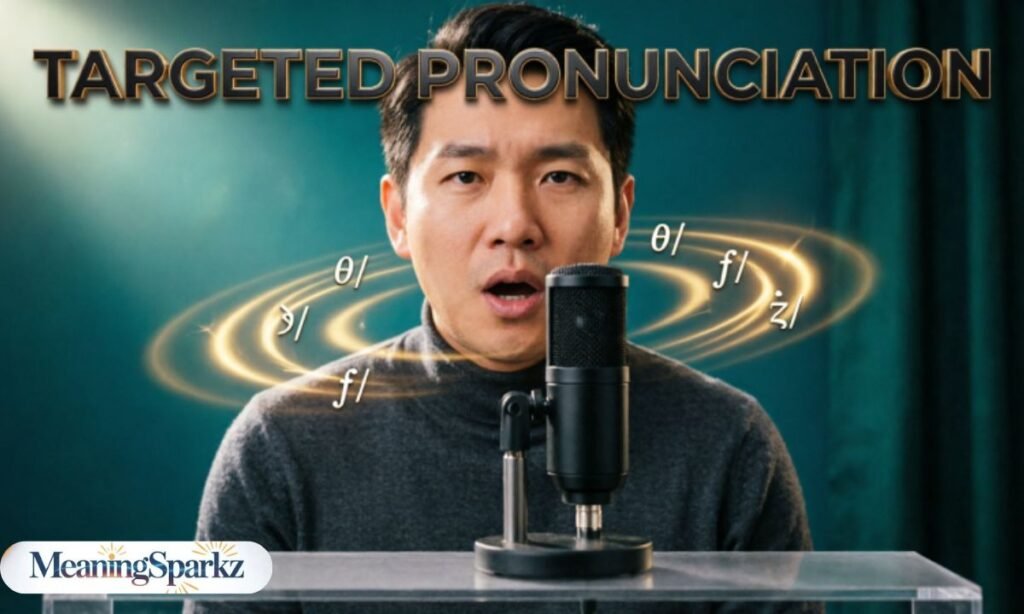
The word is pronounced in three syllables: TAR-guh-tid.
- US English: /ˈtɑːrɡɪtɪd/
- UK English: /ˈtɑːɡɪtɪd/
The stress lands firmly on the first syllable which, as covered above, is also the reason the consonant never doubles in the spelling.
Memory Trick to Never Misspell It Again
Here’s a simple formula to lock in permanently:
TARGET + ED = TARGETED (one “T” stays one “T”)
If that’s still not sticking, try this association: think of a target as something you hit with a single arrow, not a double one. One arrow, one “t.” A small mental image like this is often enough to stop the automatic urge to double the consonant when you’re typing quickly.
You can also remember it by comparing it to words that behave the same way: visit → visited, market → marketed, limit → limited. None of these double their final consonant, and “target” follows the identical pattern.
Frequently Asked Questions
Is it targeted or targetted us?
It’s targeted in American English. “Targetted” is not a recognized spelling in the US or any other English-speaking country.
Is it targeting or targetting?
It’s targeting, with a single “t.” The same no-doubling rule that applies to “targeted” applies here too.
Is targeted correct spelling?
Yes. Targeted is the correct and only accepted spelling in all major English dictionaries and style guides.
What is the opposite of targeted?
Common opposites include untargeted, random, general, broad, and unfocused, depending on context.
Summary
The rule here is refreshingly simple once you know it: targeted is correct, and targetted is a misspelling in American English, British English, and everywhere else. The confusion comes from English’s inconsistent consonant-doubling rules, but target doesn’t double its final letter because the stress falls on the first syllable, not the last.
Whenever you’re tempted to add that second “t,” remember the formula: target + ed = targeted, one “t” stays one. Get comfortable with that pattern, and you’ll never trip over this word again in professional writing, casual messages, or anywhere in between.
