

If you’ve ever paused mid-sentence wondering whether to type “invision” or “envision,” you’re not alone. This is one of the most common spelling mix-ups in English, and it trips up students, professionals, and even seasoned writers. The good news? The answer is simple once you understand where the confusion comes from.
In this guide, you’ll learn the correct spelling, why the alternative is wrong, how to use the word naturally in a sentence, and where the brand name InVision fits into all of this. By the end, you’ll never second-guess this word again.
Envision Is the Correct Word
Envision is the only correct spelling recognized by English dictionaries, including Merriam-Webster, Cambridge, and Oxford. It’s a verb that means to imagine, picture, or visualize something before it happens, usually a future outcome, goal, or possibility.
“Invision,” on the other hand, has no dictionary entry. It isn’t a regional variant, an old-fashioned spelling, or an accepted alternative. It’s simply an incorrect spelling caused by how the word sounds when spoken aloud.
Here’s a quick side-by-side comparison to settle the debate once and for all:
| Term | Correct? | Part of Speech | Meaning |
| Envision | ✅ Yes | Verb | To imagine or visualize something not yet real |
| Invision | ❌ No | Not a word | Common misspelling of “envision” |
| InVision | ✅ Yes (as a brand) | Proper noun | Name of a design software company |
| Envisage | ✅ Yes | Verb | British English equivalent of “envision” |
Why Invision Is Wrong
The mix-up comes down to prefixes. English uses both “en-” and “in-,” but they don’t attach to the same root words interchangeably.
- En- means “to cause to be” or “to put into.” It appears in words like enrich, enable, and encourage.
- In- typically means “not” or “into,” and appears in words like invisible, inactive, and incomplete.
“Vision” pairs correctly with “en-” to form envision literally, “to bring something into your mental sight.” Pairing “vision” with “in-” doesn’t follow any recognized English word-formation pattern, which is why “invision” never made it into any dictionary.
Add to that the way people pronounce the word the soft “en” sound at the start can easily be misheard as “in” and you have the perfect recipe for a persistent spelling error.
What Does Envision Mean and Usages
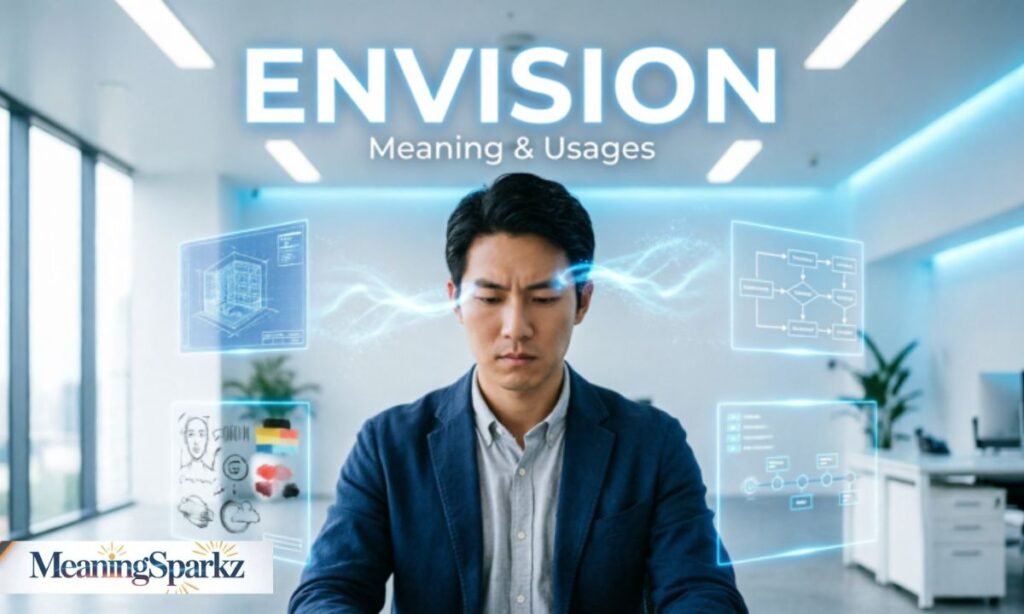
At its core, envision means to form a mental picture of something that doesn’t exist yet. It’s forward-looking by nature. You don’t envision the past or the present, you envision possibilities, plans, and outcomes.
It’s a transitive verb, meaning it needs an object. You always envision something:
- A future
- A goal
- A design
- A solution
- A version of yourself
Common conjugations include:
- Envision (base form/present) I envision a better future.
- Envisions (third-person singular) She envisions rapid growth.
- Envisioned (past tense) They envisioned a different outcome.
- Envisioning (present participle) We are envisioning new possibilities.
- Has/have envisioned (present perfect) The team has envisioned several possible outcomes.
The word traces back to the Latin root videre, meaning “to see,” combined with the prefix “en-,” which turns a noun into a verb meaning “to cause to be” or “to bring into.” Put together, envision literally means “to bring into sight” in this case, the mind’s eye rather than the physical eye. Language historians note that envision began appearing in English texts a few centuries ago, and its spelling has stayed remarkably stable ever since, unlike many older English words that shifted form over time.
Click Here To See More…
Synonyms of Envision
If you want to add variety to your writing, several words share a similar meaning to envision, though each carries a slightly different shade of nuance.
- Imagine
- Visualize
- Picture
- Foresee
- Anticipate
- Conceive
- Contemplate
- Dream up
- Envisage (mainly British English)
- Project
While these words overlap, they’re not always perfect substitutes. “Foresee” leans toward prediction, while “visualize” leans toward mental imagery. Choosing the right synonym depends on context and tone.
Here’s a quick guide to help you pick the right alternative depending on what you’re trying to express:
| Synonym | Best Used When… |
| Imagine | You want a casual, open-ended tone |
| Visualize | You’re describing a clear, detailed mental image |
| Foresee | You’re making a prediction about what will happen |
| Anticipate | You’re expecting something based on evidence or trends |
| Conceive | You’re forming an original idea or concept |
| Envisage | You’re writing for a British English audience |
| Project | You’re describing a forecast, often numerical or business-related |
Swapping in the right synonym can also help you avoid repeating “envision” too many times in a single piece of writing, which keeps your content from sounding repetitive to both readers and search engines.
Envision vs Imagine
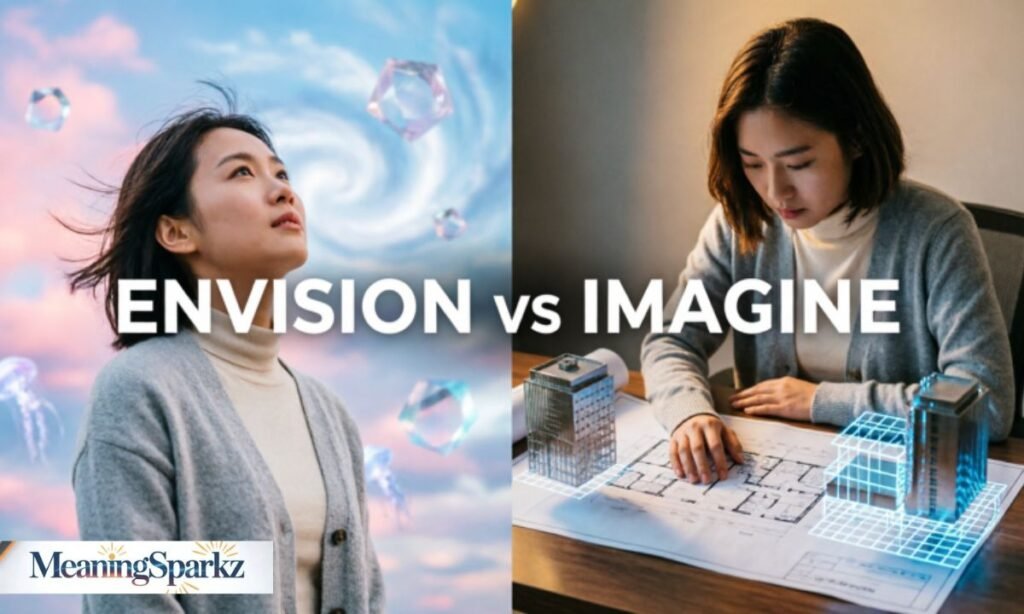
These two words are often used interchangeably, but there’s a subtle difference worth noting.
| Aspect | Envision | Imagine |
| Focus | Realistic, goal-oriented future outcomes | Any mental image, real or fantastical |
| Tone | Professional, forward-thinking | Casual, creative, open-ended |
| Common Use | Business plans, goals, strategies | Storytelling, daydreaming, hypotheticals |
| Example | “We envision a fully automated warehouse.” | “Imagine a world made of candy.” |
In short, envision usually implies a plausible, achievable future, while imagine can stretch into pure fantasy. That’s why envision shows up so often in business, leadership, and academic writing it signals intention and direction, not just creativity.
Why People Write Invision
Understanding why this mistake happens so often can help you avoid it permanently. Here are the main reasons:
- Pronunciation confusion The unstressed first syllable sounds like “in” rather than “en” in everyday speech.
- Prefix familiarity English has far more common words starting with “in-” (invisible, involve, inspire) than “en-,” so the brain defaults to the more familiar pattern.
- Brand influence The design and prototyping software company InVision is widely used by designers, developers, and product teams, and seeing that name daily can normalize the incorrect spelling in casual writing.
- Autocorrect and typing habits Fast typing combined with muscle memory from other “in-” words can produce the error without the writer noticing.
None of these reasons make “invision” acceptable in standard writing; they just explain why the mistake is so common.
How to Use Envision in a Sentence
Here are several examples showing envision in different tenses and contexts:
- I envision a career where I can combine creativity and strategy.
- The architect envisioned a building that blended into the surrounding landscape.
- Our team envisions a product that solves real customer pain points.
- She has always envisioned herself running her own company.
- What kind of future do you envision for your family?
- They envisioned a world with cleaner energy and smarter cities.
A simple test: if you can replace the word with “imagine” or “picture” and the sentence still makes sense, envision is the correct choice.
Envision in Spanish
If you’re translating or writing bilingual content, envision doesn’t translate directly word-for-word. The closest Spanish equivalents are:
- Imaginar to imagine
- Visualizar to visualize
- Prever to foresee or anticipate
For example, “I envision a better future” could translate to “Imagino un futuro mejor” or “Visualizo un futuro mejor,” depending on the tone you want to convey. There isn’t a single one-to-one Spanish verb that captures every nuance of “envision,” so context determines the best choice.
Envision Examples in Professional Writing
Professional and business contexts use envision constantly to describe vision statements, strategic goals, and leadership direction.
- “Our leadership team envisions a company culture built on transparency and accountability.”
- “The proposal envisions a phased rollout across three regions.”
- “As CEO, she envisions sustainable growth without compromising employee wellbeing.”
Envision Examples in Everyday Conversation
In casual conversation, envision still works but tends to sound slightly more polished than “imagine.”
- “I can’t quite envision what the new house will look like yet.”
- “Can you envision yourself living abroad someday?”
- “He envisions a simpler life once he retires.”
Envision in Business and Academic Writing
Business plans, research papers, and academic essays frequently rely on envision to describe hypotheses, projected outcomes, or long-term goals.
- “This study envisions a framework for reducing urban traffic congestion.”
- “The startup’s pitch deck envisions capturing 15% of the market within five years.”
- “Researchers envision new applications for this technology in renewable energy.”
Because envision conveys intentional, forward-looking thought, it adds credibility and confidence to formal writing, something “imagine” doesn’t always achieve.
InVision Software
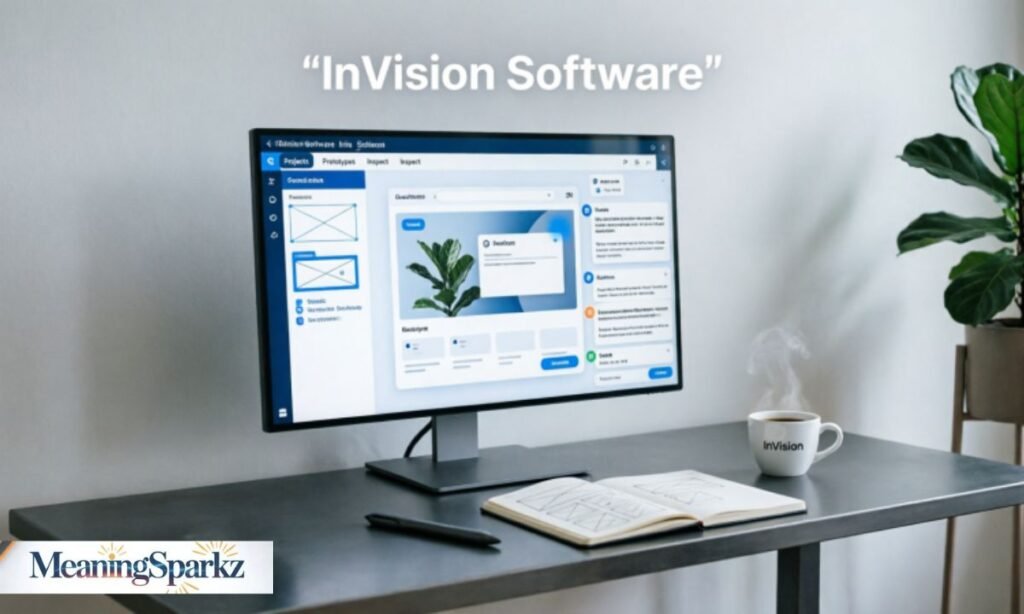
InVision is a real, capitalized brand name not a grammar exception. It refers to a well-known digital product design and prototyping platform, historically popular among UX/UI designers, product managers, and development teams for creating interactive mockups and collaborating on design workflows.
A few points to keep in mind:
- Always capitalize it as InVision (with a capital I and capital V) when referring to the company or software.
- Never use it as a substitute for the verb “envision” in a sentence about imagining or visualizing something.
- It’s a proper noun, so it should never be conjugated like a regular verb (there’s no such thing as “InVisioning a solution”).
If your sentence is about imagining a future outcome, use envision. If you’re specifically talking about the software product, use InVision.
For years, InVision was one of the go-to tools for turning static design files into clickable, interactive prototypes, helping teams test user flows before writing a single line of code. Like many tools in the fast-moving design-tech space, its popularity has shifted over time as competitors such as Figma expanded their own prototyping features. Regardless of where the brand stands today, its name remains a common reason people mistakenly type “invision” instead of “envision” simply because millions of designers have seen the brand name written out so often that it starts to feel familiar, even in the wrong context.
A helpful way to keep the two separate in your own writing: if you can swap the word for “imagine” or “picture” and the sentence still makes sense, you need the verb envision. If you’re naming a specific product, tool, or company, you need the proper noun InVision capitalized, and never conjugated like a regular verb.
Frequently Asked Questions
What is the difference between InVision and envision?
Envision is a verb meaning “to imagine or visualize.” InVision is a capitalized proper noun referring to a design software company. They’re unrelated in meaning.
What is the meaning of InVision?
InVision refers to a digital design and prototyping platform used by designers and product teams to build and share interactive mockups.
What does it mean to envision something?
To envision something means to form a clear mental picture of it, usually a future goal, outcome, or possibility that hasn’t happened yet.
Is it envisioned or invisioned?
It’s always “envisioned.” “Invisioned” is a misspelling and has no place in standard English writing.
Final Thoughts
The rule is simple: envision is the only correct spelling when you’re talking about imagining or visualizing something, while InVision only applies when you’re referring to the design software brand by name. “Invision” (lowercase, verb form) is never correct in any context.
Next time you’re unsure, remember the memory trick: think “enter the vision” envision starts with “en,” just like enrich, enable, and encourage. Get the prefix right, and you’ll never make this mistake again.
