

If you’ve ever paused mid-sentence wondering whether to type “brite” or “bright,” you’re in good company. Thousands of people run into this exact question every single day, especially after seeing brand names like Lite-Brite, Scotch-Brite, or Crest Whitestrips packaging splashed across store shelves. Those catchy labels make “brite” look like a legitimate shortcut, but is it really?
Here’s the short answer before we go any further: bright is the only correct spelling in standard English. It’s the version you’ll find in every major dictionary, every style guide, and every grammar textbook.
“Brite” is not a dictionary word, it’s a stylized, phonetic spelling that mostly lives in branding, marketing, and casual texting.
But there’s more to this story than a simple right-or-wrong answer. In this guide, we’ll walk through where each spelling comes from, what “bright” actually means, how it’s used in everyday American English, whether “brite” counts in Scrabble, what it means in German, and much more. By the end, you’ll never second-guess this spelling again.
What Does Bright Mean?
“Bright” is a versatile adjective (and occasionally a noun or adverb) that English speakers use constantly. It generally falls into four categories of meaning:
- Full of light – Something that shines, glows, or reflects a lot of light. Example: “The bright afternoon sun made her squint.”
- Vivid in color – A shade that’s bold, saturated, or eye-catching. Example: “He wore a bright yellow raincoat.”
- Intelligent or quick-witted – Describing someone sharp, clever, or academically gifted. Example: “She’s one of the brightest students in her class.”
- Cheerful, hopeful, or promising – Referring to mood, outlook, or the future. Example: “The company has a bright future ahead.”
This range of meaning is exactly why “bright” shows up in so many everyday expressions bright idea, bright side, bright future, bright smile, bright colors. It’s one of the most flexible descriptive words in the English language, which is part of why it’s so commonly searched and so easily misspelled.
Where the Word Comes From
“Bright” traces back to the Old English word beorht (sometimes spelled briht), meaning shining, radiant, or clear. That word itself descends from a much older Proto-Germanic root, berhtaz, and further back to a Proto-Indo-European root associated with shining or gleaming.
Related forms show up in Old High German (beraht), Old Saxon (berht), and even Gothic (bairhts).
This deep linguistic history is one reason “bright” has held its spelling steady for well over a thousand years long before the phonetic shortcut “b.rite” was ever invented for advertising purposes.
Brite vs bright synonym
When people search “brite vs bright synonyms,” they’re usually trying to understand words that carry similar meaning to “bright” so they can vary their vocabulary or double-check usage. Since “b.rite” isn’t a standard word, it doesn’t have synonyms of its own but “bright” certainly does, and the right synonym depends on which meaning you’re going for.
| Meaning of Bright | Common Synonyms |
| Full of light | Radiant, luminous, brilliant, glowing, dazzling |
| Vivid color | Vibrant, bold, vivid, intense, striking |
| Intelligent | Smart, sharp, clever, quick-witted, gifted |
| Cheerful/promising | Hopeful, optimistic, promising, sunny, upbeat |
A quick tip: if you’re writing and want to avoid repeating “bright” too many times in one paragraph, pick a synonym that matches the specific sense you mean. “Radiant” works beautifully for light or beauty, while “sharp” or “gifted” is better suited to describing intelligence.
Click Here To Read More >>>
Using Bright in Everyday American English
American English speakers rely on “bright” in casual conversation, professional writing, journalism, and academic work alike. It’s a word you’ll hear on the news, read in a company memo, or use to compliment a friend’s outfit.
Here are a few common ways “bright” shows up in daily American speech:
- Weather talk: “It’s supposed to be bright and sunny this weekend.”
- Compliments on intelligence: “Your daughter is incredibly bright; she picks things up so fast.”
- Describing colors: “I love how bright that shade of red looks on you.”
- Talking about the future: “Things are looking bright for the new business.”
- Everyday idioms: “Look on the bright side,” “bright-eyed and bushy-tailed,” “bright idea.”
Because “bright” fits so naturally into casual speech, professional writing, and formal documents, it never needs a stylized substitute.
Unlike words that genuinely differ between British and American English (think “colour” vs “color” or “centre” vs “center”), “bright” has no regional variant. Americans, Brits, Canadians, and Australians all spell it exactly the same way.
Bright meaning and sentence
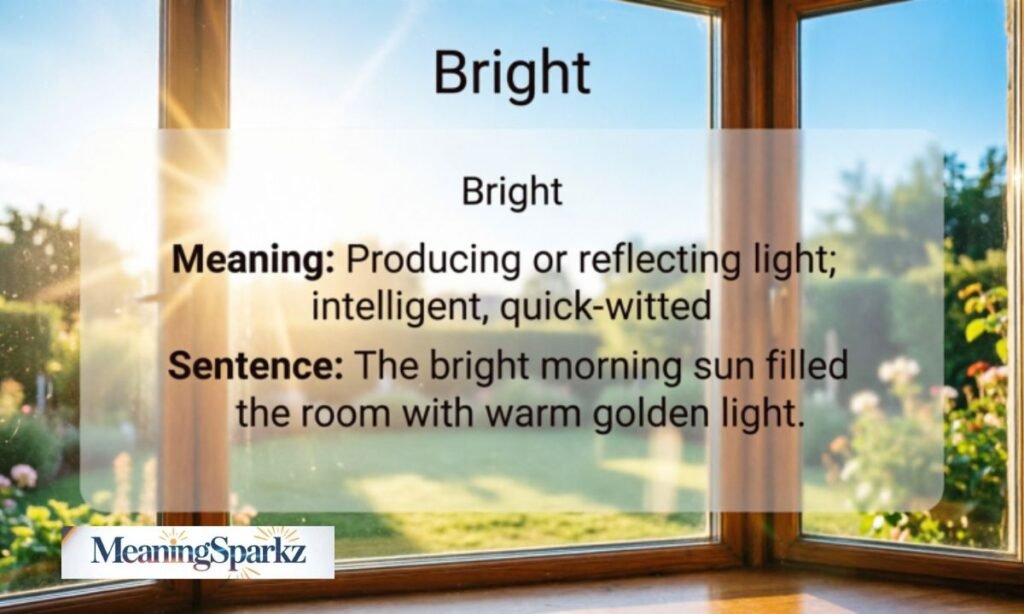
To really cement how “bright” works, it helps to see it in action across different contexts. Below are sentence examples covering each major meaning of the word.
Describing light:
- The bright headlights lit up the dark country road.
- Her bedroom gets very bright in the morning because of the east-facing window.
Describing color:
- The children painted the fence a bright shade of blue.
- She always wears bright, bold colors to work.
Describing intelligence:
- He was a bright student who graduated at the top of his class.
- Even as a toddler, she showed signs of being unusually bright.
Describing mood or outlook:
- Despite the setback, the team stayed bright and optimistic.
- We’re hoping for a bright future once the renovations are complete.
Notice how the same word carries completely different shades of meaning depending on what it’s describing light, color, intellect, or emotion. That flexibility is exactly what makes “bright” such a staple of everyday English.
What Is the Meaning of Brite?
So if “bright” is the correct spelling, what exactly is “brite,” and why does it exist at all?
“Brite” is a phonetic respelling of “bright” meaning it’s spelled the way the word sounds, without the traditional “gh.” It emerged largely through 20th-century advertising, where brands discovered that dropping the silent “gh” made a word look shorter, snappier, and more visually distinctive on packaging and signage.
You’ll typically encounter “brite” in three main situations:
- Brand and product names – Think Lite-Brite (the classic Hasbro toy), Scotch-B.rite (cleaning pads), or B.riteSmile (teeth-whitening products).
- Trademark strategy – In many jurisdictions, you can’t trademark a common dictionary word like “bright,” but a stylized spelling such as “brite” is much easier to register and protect legally.
- Casual or trendy writing – Text messages, social captions, or edgy marketing copy sometimes use “brite” for a modern, informal vibe.
Outside of these specific contexts, “b.rite” carries no separate dictionary meaning of its own; it’s simply an unofficial stand-in for “bright.” (Note: this differs from a related but distinct brewing term sometimes spelled “b.rite,” referring to a stage in beer and wine fermentation more on that kind of niche, industry-specific usage below.)
Why Brands Love the Brite Spelling
- It looks shorter and more modern on packaging.
- It’s easier to trademark than the common word “bright.”
- It creates instant brand recognition (Lite-Brite, Scotch).
- It signals a youthful, catchy, or design-forward identity.
Brite meaning in german
Interestingly, “brite” takes on a completely different and entirely legitimate meaning once you cross into German. In German, “der Brite” is a standard noun meaning “the British man” or, more broadly, “a British person.” The feminine form is “die Britin” (a British woman), and the plural is “die Briten” (British people, or “the British”).
This is a great example of a false friend in language learning: the German word “Brite” has zero connection to the English adjective “bright” or the marketing spelling “brite.” They’re simply homophone-adjacent spellings from two unrelated languages.
If you’re learning German and see “Brite” in a sentence, don’t confuse it with the English spelling debate context which will make the meaning obvious, since it’s almost always referring to nationality.
Example in German: “Mein Nachbar ist Brite.” “My neighbor is British.”
Is brite a Scrabble word
This is one of the most common follow-up questions once people learn “brite” isn’t a standard dictionary word and the answer disappoints Scrabble fans every time.
No, “brite” is not an accepted word in official Scrabble dictionaries, including both the Official Scrabble Players Dictionary (OSPD) used in North America and the Collins Scrabble Words (CSW) list used internationally. Since tournament Scrabble relies strictly on recognized dictionary entries, and “brite” hasn’t earned a spot in mainstream dictionaries, it can’t be played for points in an official match.
Quick reference:
| Word | Valid in Scrabble? |
| Bright | ✅ Yes |
| Brite | ❌ No |
| Brights (plural/noun use) | ✅ Yes (in certain contexts, e.g., car headlights) |
| Brites | ❌ No |
So if you’re hoping to sneak “brite” onto the board during game night, you’ll want to challenge that word if it won’t hold up.
Bright person meaning
When someone calls another person “bright,” they’re almost always complimenting that person’s intelligence, quick thinking, or academic ability not describing anything to do with light or color. A “bright person” typically means:
- Someone who learns new information quickly.
- Someone who shows strong problem-solving skills.
- A student who performs exceptionally well in school.
- Someone whose ideas or insights stand out as clever or original.
This usage has been part of English for centuries, tracing back to the same root meaning of “shining” the idea being that intelligence “shines” through a person, much like light. That’s also why we say someone has a “bright mind” or a “brilliant idea” (notice “brilliant” shares the same light-based origin).
Examples of “Bright Person” in Sentences
- “She’s such a bright person; she finished the entire project ahead of schedule.”
- “Even as a child, he was known as the bright one in the family.”
- “Bright students often ask more questions in class.”
In every one of these examples, swapping in “brite” would be flagged as a spelling mistake this usage always calls for the standard “bright.”
Can You Spell Bright as Brite?
Technically, you can type the letters “b-r-i-t-e” but nothing stops you physically. But should you? In almost every practical writing situation, the answer is no.
Here’s a clear breakdown of when each spelling is acceptable:
| Context | Correct Spelling |
| School essays and academic papers | Bright |
| Business emails and reports | Bright |
| Journalism and blog writing | Bright |
| Legal or professional documents | Bright |
| Referencing an existing brand name (e.g., Lite-Brite) | Brite |
| Creating a new brand, product, or trademark | Brite (stylistic choice) |
| Casual texting for fun or trendiness | Brite (informal only) |
Major style authorities, including the Associated Press Stylebook and the Chicago Manual of Style, only recognize “bright” as correct. Teachers, editors, and hiring managers will treat “brite” as a spelling error unless it’s clearly referencing a brand name.
A Simple Memory Trick
One of the easiest ways to remember the correct spelling: notice that “bright” contains the word “right” inside it (b-right). Since “bright is right,” you’ll never confuse the two again. Another popular trick is remembering that the “gh” represents the “glow” real brightness needs those letters, while marketing shortcuts don’t.
Frequently Asked Questions
Is “brite” ever grammatically correct?
No. It’s only acceptable when referring to a brand, product name, or deliberately informal writing style.
Why do brands use “brite” instead of “bright”?
Mainly for easier trademarking, a shorter look on packaging, and a modern, catchy feel.
Do “bright” and “brite” sound different?
No, both are pronounced exactly the same way: /braɪt/.
Is “brite” recognized in any English dictionary?
No major dictionary lists “brite” as a standard entry.
What’s the origin of the word “bright”?
It comes from Old English beorht, meaning shining or radiant, with roots going back to Proto-Germanic and Proto-Indo-European.
Can I use “brite” in a college essay?
No, it will likely be marked as a spelling error and could lower your grade.
Is “brite” valid in Scrabble?
No, it’s not accepted in official Scrabble dictionaries.
Does “Brite” mean something in German?
Yes, “der Brite” means “the British man” or “British person” in German.
What does it mean if someone calls me “bright”?
It usually means they think you’re intelligent, quick-thinking, or academically talented.
Is there a British vs American spelling difference for this word?
No, both British and American English use “bright” as the only correct spelling.
Final Verdict
After digging through the history, meaning, and real-world usage of both spellings, the verdict is clear: bright is the correct, standard spelling, and it’s the one you should use in virtually every writing situation: essays, emails, articles, resumes, and everyday conversation.
It carries over a thousand years of linguistic history, appears in every reputable dictionary, and covers a wide range of meanings from physical light to intelligence to hopeful outlooks.
“Brite,” on the other hand, is a modern marketing invention, a phonetic shortcut designed to look catchy on product labels and trademarks. It has its place in brand names like Lite-Brite or Scotch-Brite and in casual, playful writing, but it has no home in formal or professional contexts.
So the next time you’re typing away and your fingers hesitate between the two, remember the simple rule: unless you’re naming a product or referencing an existing brand, always choose bright. It’s the spelling your teachers expect, your employer requires, and your readers will recognize as correct every single time.
