

If you’ve ever paused mid-sentence wondering whether to type “thats” or “that’s,” you’re in good company. This tiny apostrophe trips up native speakers, ESL learners, professionals, and students alike. It looks like such a small detail, yet it changes how polished your writing appears and even how search engines and readers judge your credibility.
The good news? The rule is simple once you understand it, and this guide will make sure you never second-guess it again. We’ll cover the exact meaning, real-world examples, memory tricks, texting usage, grammar rules, and answers to the most common questions people ask about this pair.
By the end of this article, you’ll know exactly when to use “that’s,” why “thats” is never correct in standard writing, and how to explain the difference to anyone who asks.
This confusion isn’t rare, either. It’s one of the most frequently searched grammar questions in English, right up there with “its vs it’s” and “your vs you’re.” That’s largely because the words look almost identical on the page, the mistake rarely trips up pronunciation, and spell-checkers don’t always flag it as an error.
A missing apostrophe doesn’t create a nonsense word the way a genuine misspelling would, it just quietly slips past, especially in fast typing, casual messaging, and first drafts. This guide draws on standard grammar references and real writing patterns to give you a rule you can apply instantly, whether you’re proofreading an email, editing a report, or just double-checking a text before you hit send.
The Short Answer: “Thats” vs “That’s”
Here’s the quick version before we go deeper: “That’s” is correct. “Thats” is not a real word in standard English.
“That’s” is a contraction, a shortened combination of two words joined together with an apostrophe. It stands for either:
- “That is” as in, “That’s my phone.”
- “That has” as in, “That’s been a long week.”
“Thats,” without the apostrophe, doesn’t appear in any major dictionary and has no accepted grammatical function. It’s almost always a typo caused by fast typing, autocorrect skipping the mark, or a keyboard that makes apostrophes easy to miss.
Here’s a simple table to lock in the difference:
| Form | Correct? | What It Means | Example |
| That’s | ✅ Yes | Contraction of “that is” or “that has” | “That’s amazing news.” |
| Thats | ❌ No | Not a recognized English word | “Thats amazing news.” (incorrect) |
If you remember nothing else from this article, remember this: whenever you mean “that is” or “that has,” the apostrophe has to be there. Skip it, and you’ve written something that doesn’t officially exist in the language.
It helps to think of the apostrophe as a signal rather than decoration. In English, apostrophes in contractions always mark a spot where letters were removed to make two words flow together as one. “Don’t” drops the “o” from “not.” “I’m” drops the “a” from “am.”
“That’s” drops the “i” from “is,” or several letters from “has.” Once you see the apostrophe this way as a placeholder, not an optional flourish the rule becomes almost impossible to forget.
That’s in a Sentence
Seeing “that’s” used correctly across different sentence types helps the rule stick faster than any explanation alone. Here are several natural examples, spanning casual speech, professional writing, and storytelling:
- That’s exactly what I was thinking.
- That’s the restaurant we went to last summer.
- That’s not going to work for our timeline.
- That’s been on my to-do list for weeks.
- “That’s incredible,” she said, shaking her head.
- That’s a fair point, and I hadn’t considered it.
- That’s why the meeting got rescheduled.
- That’s the version we should send to the client.
Notice how “that’s” fits naturally at the start of a sentence, in the middle of dialogue, and inside more formal statements. It’s flexible precisely because it’s doing the job of two different word pairs depending on context, which we’ll break down next.
Here are a few more examples across different writing situations, so you can see just how versatile the word is:
- In business writing: “That’s the figure we submitted to finance last quarter.”
- Customer service replies: “That’s a valid concern, and we’ll look into it right away.”
- In creative writing: “That’s the last time I trust a stranger’s directions,” he muttered.
- In educational content: “That’s how photosynthesis converts sunlight into usable energy.”
- In social media captions: “That’s a wrap on 2026! See you next year.”
Across every one of these examples, the apostrophe is doing real grammatical work; it’s not there for style, and removing it would technically break the sentence, even if most readers wouldn’t consciously notice why it looks off.
Click Here To Read Soo vs So
What Does “That’s” Mean?
“That’s” isn’t a single-purpose word it’s a stand-in for two different phrases. Which one it represents depends entirely on the words that follow it in the sentence. Understanding both uses is the real key to mastering this contraction.
“That’s” as “That Is”
The most common use of “that’s” replaces “that is.” You’ll reach for this version when you’re identifying something, making a statement, or describing a current situation.
Examples:
- That’s my jacket on the chair. → That is my jacket on the chair.
- That’s a great idea. → That is a great idea.
- That’s the house at the end of the street. → That is the house at the end of the street.
In each case, “that’s” is simply a faster, more natural-sounding way to say “that is.” This version dominates everyday conversation because it flows better and feels less stiff than the full phrase.
“That’s” as “That Has”
Less commonly, “that’s” stands in for “that has,” typically when it’s paired with the present perfect tense meaning it’s followed by a past participle like “been,” “gone,” “happened,” or “changed.”
Examples:
- That’s been sitting on my desk for a week. → That has been sitting on my desk for a week.
- That’s already been discussed in the last meeting. → That has already been discussed in the last meeting.
- That’s changed everything about the plan. → That has changed everything about the plan.
Here’s a quick way to tell the two apart: if the word right after “that’s” is a verb ending in “-ed” or an irregular past participle (been, gone, done, seen), you’re almost certainly looking at “that has.” If it’s an adjective or a noun, it’s usually “that is.”
| Use Case | Expands To | Signal Word After “That’s” | Example |
| Identifying or describing | That is | Adjective / noun | That’s a good plan. |
| Present perfect tense | That has | Past participle (been, gone, happened) | That’s happened before. |
It’s worth noting that context almost always resolves any ambiguity instantly for a reader. Even though “that’s” theoretically covers two different underlying phrases, native speakers rarely pause to figure out which one is meant.
The surrounding words make it obvious within a fraction of a second. This is actually one of the reasons “that’s” works so well as a contraction: it’s efficient without sacrificing clarity.
Common Mistakes People Make With “Thats” and “That’s”
Beyond simply forgetting the apostrophe, a few related errors tend to show up alongside this mix-up. Knowing them helps you avoid a cluster of small mistakes at once:
- Treating “thats” as a plural. Some writers subconsciously pattern-match “that” the way they would a countable noun, adding an “s” as if forming a plural. But “that” has no plural form created this way; the plural of “that” is “those,” which is a completely different word, not a variation with an “s” tacked on.
- Confusing “that’s” with possession. A few writers assume “that’s” can show ownership, similar to “the teacher’s desk.” It never does. “That’s” is strictly a contraction, never a possessive marker.
- Dropping the apostrophe under time pressure. This is by far the most common cause of fast typing, texting, or drafting without proofreading. The fix isn’t more grammar knowledge; it’s simply a quick reread before sending or publishing.
- Autocorrect gaps. Not every keyboard or app catches a missing apostrophe the way it catches a true misspelling, so “thats” can slip through even careful writers’ final drafts.
- Overcorrecting into “that is” everywhere. Some writers, once they learn contractions can be “wrong” in formal writing, start avoiding “that’s” entirely, even in casual contexts where it sounds far more natural. Both forms are correct; the goal is matching tone, not avoiding contractions altogether.
Is “Thats” a Word?
No, “thats” is not a word in standard English. It doesn’t appear in Merriam-Webster, Oxford, Cambridge, or any other major dictionary as a valid entry. It’s not a contraction, not a plural, not a possessive, and not an alternate spelling of anything.
So why does it show up so often in emails, texts, and even published content? A few reasons explain most cases:
- Typing speed Apostrophes require an extra keystroke, and fast typists sometimes skip them without noticing.
- Mobile keyboards Autocorrect doesn’t always catch a missing apostrophe the way it catches misspelled words.
- Habit from other plurals English speakers are used to adding “s” to make words plural (cat → cats), and the brain sometimes applies that pattern incorrectly to “that.”
- Confusion with possessives Some writers mistakenly think “thats” could show possession, similar to “the dog’s bowl.” It never does. “That” has no possessive form in modern English.
The one narrow exception worth knowing: a compact car released by Honda in Japan between 2002 and 2007 was branded as the “Honda That’s,” using the apostrophe as a stylistic touch. Outside of that specific product name, “that” has no legitimate use anywhere in the English language.
Editors, teachers, and professional proofreaders treat this as one of the more forgivable typos precisely because it’s so mechanical it rarely signals a genuine misunderstanding of grammar.
Most people who write “thats” already know the rule; their fingers just move faster than their punctuation. Still, in published content, resumes, client emails, and academic work, that small slip can register as a lack of attention to detail, so it’s worth catching every time.
How to Remember the Difference Between “Thats” and “That’s”
If the rule ever slips your mind mid-sentence, these memory tricks make it easy to self-correct in seconds:
- The Replacement Test: Swap “that’s” with “that is” or “that has.” If the sentence still makes sense, the apostrophe belongs there. If it sounds broken, you probably need plain “that” instead.
- The Missing Letter Rule: Every contraction’s apostrophe marks a spot where letters were removed. In “that’s,” it stands in for the missing “i” in “is” or part of “has.” No apostrophe means nothing was contracted so the word shouldn’t exist.
- Say It Out Loud: Read your sentence aloud. If you naturally hear yourself saying “that is” or “that has,” the written version needs the apostrophe.
- Visual Cue: “That’s” always has an apostrophe doing work. “Thats” looks like a plural, but “that” doesn’t pluralize by adding “s” so a bare “thats” is a red flag every time.
- One-Second Check: Before hitting send on a text or email, glance for any “thats” and ask, “Am I trying to say that is or that has?” If yes, add the apostrophe immediately.
Practicing this test consistently even for a few weeks trains your eye to catch the mistake automatically, the same way trained proofreaders spot it instantly.
If you write frequently for work, school, or content creation it also helps to build a habit of a final read-through before publishing anything. Reading your own writing slowly, word by word, catches far more small errors than skimming does.
Many writers find it useful to read backward, sentence by sentence from the end of the piece, since this breaks the brain’s tendency to autocorrect mistakes visually while reading in normal order.
That’s Meaning in Texting
In texting, social media, and casual chat apps, “that’s” keeps its full meaning and grammatical role; it’s simply used more informally and more frequently than in academic writing. Because texting favors speed and brevity, this is actually where “thats” (missing the apostrophe) shows up most often, purely from fast thumbs rather than any real confusion about grammar.
Common texting examples where “that’s” appears naturally:
- “omg that’s hilarious ????”
- “that’s fine, see you at 7”
- “wait that’s not what I meant”
- “that’s already been sent, don’t worry”
Even in the most casual digital spaces, using the apostrophe correctly makes a small but real difference. Text messages without it can look rushed or careless, while messages with proper punctuation read as more deliberate even in a five-word reply. If clarity and tone matter to you, even in texting, keeping the apostrophe is a habit worth building.
One helpful mental shortcut for texting specifically: your phone’s autocorrect usually inserts the apostrophe for you if you type “thats” and it recognizes the word pattern. But this isn’t guaranteed on every keyboard or app, so it’s worth a quick glance before sending anything important: a client message, a work Slack, or a text you don’t want to walk back.
There’s also a generational and platform element worth mentioning. On platforms like X, Instagram, and TikTok captions, dropped apostrophes are common enough that they rarely draw attention; the culture of those spaces tolerates fast, imperfect typing as part of the format.
On LinkedIn, in professional email threads, or in a cover letter, the same missing apostrophe reads very differently, often as carelessness rather than casual style. Knowing your platform helps you decide how strict you are with yourself at the moment.
When to Use “That’s” in Your Writing
“That’s” is appropriate in nearly every writing context you’ll encounter, but knowing when it fits best (and when to consider the full form instead) makes your writing sound more intentional.
Use “that’s” when:
- Writing conversationally in blog posts, emails, or social captions
- Writing dialogue in fiction or scripts, where natural speech patterns matter
- Communicating in a friendly or semi-formal tone at work
- Texting, messaging apps, or any informal digital communication
- Explaining or clarifying a point in a way that should feel approachable
Consider spelling out “that is” or “that has” when:
- Writing formal academic papers, theses, or research documents
- Drafting legal contracts, official reports, or government documents
- Following a specific style guide that discourages contractions
- Aiming for a deliberately formal, authoritative tone
Here’s a comparison to illustrate the tonal shift:
| Register | Example |
| Formal | That is the recommended procedure for handling client complaints. |
| Semi-formal | That’s the recommended procedure for handling client complaints. |
| Casual/Texting | that’s the move for handling complaints tbh |
Neither form is “more correct” grammatically both “that’s” and “that is” are valid English. The choice comes down to tone and audience. What’s never valid, in any register, is “thats” without the apostrophe.
A useful habit for writers who move between registers often say, drafting a casual blog post in the morning and a formal report in the afternoon is to decide on tone before writing rather than during editing.
If you know upfront that a piece calls for a conversational voice, you can use contractions like “that’s” freely and consistently. If the piece calls for formality, spelling out “that is” or “that has” throughout keeps the tone even, rather than mixing contracted and full forms inconsistently within the same document.
Thats or That’s: Grammar Rule Summary
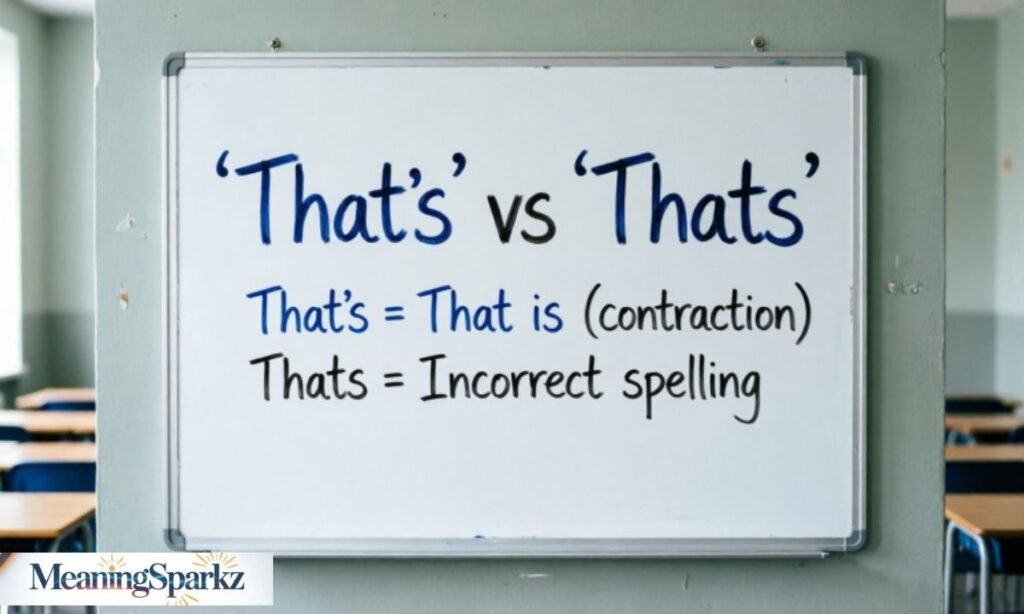
Let’s consolidate everything into one clear grammar rule you can rely on permanently:
Golden Rule: Whenever you mean “that is” or “that has,” always write “that’s” with an apostrophe. There is no context formal, informal, academic, or casual where “thats” without an apostrophe is the correct choice.
Here’s the rule broken into a quick reference table:
| Rule | Explanation |
| Contractions need apostrophes | Just like “don’t,” “it’s,” and “we’re,” “that’s” requires an apostrophe to show missing letters. |
| Two possible meanings | “That’s” can mean “that is” or “that has,” depending on context. |
| No possessive form | “Thats” is never possessive. Possession would require a different structure entirely. |
| Works in all registers | “That’s” is grammatically correct in formal, semi-formal, and informal writing alike. |
| “Thats” is always wrong | Outside of a specific product name, “thats” has no valid use in standard English. |
This single rule resolves nearly every instance of confusion people run into with this word pair. If you keep this table in mind, you’ll rarely need to double-check again.
It’s also worth understanding why this rule doesn’t bend the way some grammar guidelines do over time. Language evolves constantly slang shifts, new words enter dictionaries every year, and even punctuation conventions loosen in some areas, like the declining use of the Oxford comma in certain style guides.
But contraction rules have stayed remarkably stable because they serve a clear functional purpose: showing readers exactly where letters were removed so meaning stays unambiguous. That functional stability is why “that’s” has kept its apostrophe consistently across decades of usage, and why it’s unlikely to change anytime soon.
Frequently Asked Questions
When to use “thats” and “that’s”?
Use “that’s” whenever you mean “that is” or “that has.” “Thats” should never be used it isn’t a standard English word in any writing context, formal or informal.
Is there an apostrophe in “thats”?
Yes, there should be. The correct spelling is always “that’s,” with the apostrophe marking the missing letters from “is” or “has,” never left out.
What is the difference between “that” and “those”?
“That” refers to one singular item or idea, while “those” refers to multiple items for example, “that book” versus “those books” on the shelf.
What is the difference between “that’s” and “it’s”?
“That’s” means “that is” or “that has” and typically points to something specific being identified, while “it’s” means “it is” or “it has” and refers back to something already mentioned.
Final Thoughts
The difference between “thats” and “that’s” comes down to a single punctuation mark, but that mark carries real weight. “That’s” is the only correct form, standing in for “that is” or “that has” depending on the sentence.
“Thats” simply doesn’t exist in standard English, and using it even by accident can make writing look rushed or unpolished.
The fix is easy: run the replacement test, say the sentence out loud, or picture the apostrophe as a placeholder for missing letters. With a little practice, choosing correctly becomes automatic, whether you’re texting a friend, writing a blog post, or finalizing a professional report.
Small details like this one are exactly what separate confident, credible writing from writing that makes readers pause. Whether you’re writing a quick text, a professional email, a blog post, or an academic paper, applying this rule consistently signals care and attention qualities readers and search engines both tend to reward.
The next time your fingers move faster than your thoughts and “thats” almost slips through, pause for one second, run the replacement test, and add the apostrophe where it belongs.
It’s a small habit, but over time it becomes second nature and your writing will read as sharper, clearer, and more professional because of it. Now that you know the rule inside and out, you’ll never have to wonder again that’s a promise.
