

( Soo vs So ):
Scroll through any comment section, group chat, or Instagram caption and you’ll spot it almost instantly: an extra “o” sitting where it doesn’t technically belong. “I’m soo tired.” “That dress is soo cute.” “We’re soo done with this week.”
It looks like a typo. It isn’t. It’s a deliberate style choice that has quietly become part of everyday digital English and it sits right next to one of the most-used words in the language: so.
If you’ve ever paused mid-sentence wondering whether to type “so” or “soo,” you’re not overthinking it. The two spellings look almost identical, sound exactly the same out loud, and yet send completely different signals to a reader. One is grammatically bulletproof. The other is emotional shorthand that only works in the right room.
This guide breaks down the real difference between soo and so the grammar, the psychology, the pronunciation, the business use cases, and the internet culture behind it so you never have to second-guess which one to type again.
“So” – Why It’s Always Correct
Let’s start with the word that actually belongs in a dictionary: so.
“So” traces back to Old English swā, meaning “in this way” or “to this extent.” It has been doing heavy lifting in English sentences for over a thousand years, and it still shows up in almost every register of writing from legal contracts to text messages.
Grammatically, “so” wears several hats:
- An adverb of degree intensifies an adjective or another adverb: “She is so talented.”
- Conjunction links cause and result: “It started raining, so we left early.”
- A discourse marker signals a transition or opens a thought: “So, where do we start?”
- The substitute word stands in for something already mentioned: “I think so.”
Because “so” is a recognized, standard-dictionary word with a fixed spelling, it’s accepted in every context essays, emails, resumes, news articles, and casual chats alike.
There’s no situation where writing “so” is technically wrong. That’s precisely why it earns the label “always correct”: its correctness isn’t dependent on tone, platform, or audience.
Consider how many everyday sentences quietly depend on “so” to hold their logic together:
- Result: “The flight was delayed, so we missed the connection.”
- Purpose: “Speak up so everyone can hear you.”
- Emphasis: “That was so unexpected.”
- Agreement/reference: “If you think it’s a good idea, I do so too.”
- Conversational opener: “So, how did the interview go?”
Notice that in every example above, removing “so” or swapping it for “soo” would either break the sentence’s logic or simply look like a typo. That’s the core distinction worth remembering: “so” is load-bearing.
It’s doing actual grammatical work connecting clauses, showing cause and effect, or modifying another word. “Soo” never does any of that work; it only rides on top of “so” to add volume.
This is also why English teachers, editors, and style guides never flag “so” as a problem word on its own. It only becomes an issue when it’s overused as a filler (“So, so, so many things happened”) or when a writer starts every sentence with it out of habit. The word itself, spelled correctly, is never wrong.
Key takeaway: “So” is standard English. “Soo” is not. Everything else in this guide builds on that one fact.
Soo vs So Meme
Before diving deeper into grammar, it’s worth acknowledging why this topic (Soo vs So) even trends online in the first place: memes.
“Soo” became internet shorthand largely through captions, reaction posts, and comment threads where people needed to show excitement, sarcasm, or disbelief that plain text couldn’t carry on its own. Think of viral formats like:
- “Me: I’m fine. Also me: sooo not fine.”
- A stretched-out “soooo relatable” under a screenshot.
- Sarcastic captions like “soo this happened” under an awkward photo.
The extra vowels function almost like a sound effect, a written stand-in for a raised eyebrow, a drawn-out sigh, or a dramatic pause. Meme culture leaned into this because stretching a word visually mimics how we stretch it vocally when we’re being sarcastic or exaggerated. It’s not laziness; it’s tone compression. A single extra letter carries emotional weight that a plain “so” simply can’t deliver in text form.
This is also why “soo” spreads so easily in meme captions but almost never appears in the memes’ own source articles, news write-ups, or anywhere formal because the moment the joke needs to be taken seriously, the spelling reverts to “so.”
There’s also a specific “soo vs so” meme format that circulates on grammar and language pages: a split image or side-by-side comparison showing a calm, composed person labeled “so,” next to an exaggerated, over-the-top reaction labeled “soo.”
The joke writes itself one letter, and suddenly the same sentence goes from measured to theatrical. These formats do more than entertain; they’ve genuinely helped cement “soo” as a recognizable stylistic choice rather than a random typo, because millions of people have now seen the two spellings deliberately contrasted for comedic effect.
Group chats have their own version of this joke too. A friend who normally texts in short, neutral sentences suddenly typing “I’m SOOO in” or “this is soo not okay” signals a shift in energy that everyone in the chat picks up on instantly without needing a single extra word of explanation. That instant, shared understanding is exactly why the spelling persists, meme or not.
Click Here To Read Proposed vs Purposed
Is “Soo” a Real Word or Just Internet Slang?
Short answer: no, “soo” is not a recognized English word. You won’t find it listed with its own definition in Merriam-Webster, Oxford, or Cambridge dictionaries.
What it actually is: a nonstandard, stylistic spelling of “so,” created by stretching the vowel sound to mimic how people naturally elongate words when speaking with emotion. Linguists refer to this kind of thing as expressive lengthening a way writers add tone or feeling to text that would otherwise read as flat.
Compare these two sentences:
- “I’m so excited.” Clear, correct, neutral-to-positive.
- “I’m soo excited!!” Same meaning, but visually louder, more animated, and clearly informal.
Neither sentence changes meaning. What changes is perceived intensity. That’s the entire function “soo” serves: it’s a volume knob for emotion, not a grammatical tool.
The Urban Dictionary Definition Soo vs So
Urban Dictionary the internet’s crowdsourced slang archive does list “soo,” and its user-submitted entries generally describe it as an exaggerated, emphasized version of “so,” used to express strong feeling, sarcasm, or emphasis in casual writing. Entries commonly cite examples like “soo good,” “soo done,” or “soo over it.”
It’s worth noting that Urban Dictionary is not a linguistic authority; it’s a slang crowdsourcing platform, not a dictionary in the traditional sense. Its inclusion of “soo” simply confirms what’s already obvious from everyday internet use: the term is common, understood, and culturally embedded, even though it holds zero standing in formal grammar.
So Pretty or Soo Pretty
This is one of the most searched real-world examples of the soo vs so debate, and it’s a great case study because the phrase shows up constantly across Instagram captions, TikTok comments, and text messages.
| Phrase | Best Used In | Tone |
| “You look so pretty.” | Compliments in person, formal messages, reviews, captions meant to read as genuine | Warm, sincere, polished |
| “You look soo pretty!” | Texts to friends, Instagram comments, casual DMs | Enthusiastic, animated, informal |
Both (Soo vs So) phrases mean the same thing. The difference is entirely about register how formal or casual the moment calls for. “So pretty” reads as a clean, sincere compliment that would look perfectly natural in a blog post, a product review, or even a wedding speech. “Soo pretty” reads like something typed quickly, with genuine excitement, in a comment section.
Neither is “wrong” in casual contexts but if you’re writing anything that needs to be taken seriously (a caption for a brand account, a professional bio, a customer testimonial you’re publishing), “so pretty” is the safer, more polished choice every time.
Soo vs So – Key Differences
At this point, the pattern should be clear. Here’s the direct, side-by-side comparison Soo vs So:
| Feature | So | Soo |
| Dictionary status | Standard English word | Not a recognized word |
| Grammatical role | Adverb, conjunction, discourse marker | None purely stylistic |
| Formal writing | Always appropriate | Never appropriate |
| Casual/social writing | Appropriate | Appropriate, used for emphasis |
| Pronunciation | /soʊ/ | /soʊ/ (identical) |
| Change sentence meaning? | Yes, functionally | No, only emotional tone |
| SEO/search engine treatment | Recognized as meaningful text | Ignored or seen as informal noise |
| Professional credibility | Maintains it | Can lower it |
The Emotional Impact Difference (Soo vs So)
The single biggest distinction between these two spellings isn’t grammar, it’s emotional volume.
“So” is a whisper-to-normal-voice word. It intensifies, connects, or transitions without drawing attention to itself. “Soo” is a raised-voice word. It’s the written version of stretching a syllable out loud to make sure the listener feels what you’re feeling, not just understands it.
That’s why “soo” tends to show up around:
- Excitement “I’m soo ready for this trip!”
- Frustration: “This traffic is soo annoying.”
- Sarcasm “Yeah, soo believable.”
- Affection “I miss you soo much.”
In every case, swapping in “so” wouldn’t change what’s being said, it would just turn the emotional dial down.
When Context Changes Everything (Soo vs So)
Context is what ultimately decides which spelling is appropriate, not personal preference. A few quick tests to run before you type “soo”:
- Who’s reading this? A friend, follower, or customer casually browsing social media “soo” is fine. A recruiter, client, teacher, or editor sticks with “so.”
- Where is this published? Instagram captions, texts, and casual blog posts have room for “soo.” Reports, resumes, emails, and articles do not.
- What’s the goal? If you want to sound credible and clear, “so” wins. If you want to sound animated and relatable, “soo” can work sparingly.
SOO Meaning in Business

Outside of grammar entirely, “SOO” also appears as a business acronym, and it’s worth clarifying so there’s no confusion with the “so vs soo” spelling debate.
In professional and supply-chain contexts, SOO commonly stands for Statement of Objectives, a document used in project management, government contracting, and procurement that outlines the broad goals of a project without dictating the exact methods a contractor must use to achieve them. It’s often paired with related terms like:
- SOW – Statement of Work (more detailed, task-specific)
- PWS – Performance Work Statement
A Statement of Objectives typically gives contractors flexibility to propose their own approach, as long as they meet the stated goals making it a popular format in government and enterprise RFPs (Requests for Proposal).
This is a completely different “SOO” from the casual, stretched-vowel spelling of “so.” Context makes the distinction obvious: if you’re reading a procurement document, SOO means Statement of Objectives. If you’re reading a text message, “soo” is just an emotionally emphasized “so.”
When to Use “So” (And When to Avoid “Soo”)
Here’s a practical, no-fluff breakdown Soo vs So:
Use “so” when writing:
- Emails and business correspondence
- Academic essays and research papers
- Resumes, cover letters, and LinkedIn profiles
- Blog posts, articles, and website copy
- Legal, technical, or official documents
- Any content meant to rank in search engines
“Soo” can work when writing:
- Texts to close friends or family
- Casual social media captions or comments
- Personal, conversational blog posts with a playful brand voice
- Fan pages, meme accounts, or Gen Z-targeted content used intentionally, not habitually
The Credibility Factor (Soo vs So)
Readers form snap judgments about a writer’s competence based on small details and nonstandard spelling is one of the fastest ways to lose credibility, even if the underlying idea is strong.
Imagine two versions of a product review Soo vs So:
- “The build quality is so solid, and the battery life is genuinely impressive.”
- “The build quality is soo solid, and the battery life is soo impressive!!”
The first sounds like a professional review. The second sounds like a quick comment left under a friend’s post. Neither is factually different, but only one builds trust with a reader who doesn’t know you.
In professional and SEO content specifically, “soo” also does nothing for search visibility search engines process “so” as a real linguistic unit; “soo” typically registers as noise or a misspelling.
This credibility gap shows up in very concrete, real-world situations:
- Job applications: A cover letter that says “I’m soo excited about this opportunity” reads as unpolished, even if the candidate is genuinely well-qualified.
- Client communication: A freelancer emailing “the project is soo close to done” risks sounding less organized than one who simply writes “the project is nearly complete.”
- Published content: Articles, guides, and reports that slip into “soo” mid-paragraph break the professional tone the rest of the piece worked to establish.
- Customer support: A support agent typing “soo sorry about that” in a live chat can come across as overly casual for a service interaction, depending on the brand’s tone guidelines.
None of these examples involve a factual error; the meaning is perfectly clear either way. But readers, recruiters, editors, and clients are constantly (often unconsciously) scanning for small signals of care and professionalism, and spelling is one of the fastest signals available. Choosing “so” over “soo” in these contexts costs nothing and protects your credibility every time.
When “Soo” Actually Works (Social Media & Casual Texts)
Not every piece of writing needs to sound like a press release. “Soo” earns its place when the entire point of the message is to communicate feeling fast, informally, and with personality. It works well in:
- Instagram/TikTok captions meant to feel spontaneous
- Group chats where tone matters more than polish
- Comment replies expressing genuine reaction (“soo real,” “soo true”)
- Fandom and community spaces where stretched spelling is part of the shared voice
Used sparingly and intentionally, “soo” adds warmth. Used constantly, it starts to read as filler the written equivalent of overusing exclamation points.
How Brands Use “Soo” Strategically
Interestingly, some brands deliberately break the “always use so” rule on purpose, and only in specific channels.
Youth-focused, lifestyle, beauty, and D2C brands sometimes use “soo” in social captions or ad copy to sound more relatable and less corporate.
A skincare brand might caption a product photo “this serum is soo good it’s unfair,” because the informal spelling matches the platform (Instagram/TikTok) and the audience (younger, casual, scroll-fast readers).
The key pattern brands follow:
- “Soo” appears in social captions, never in product descriptions or legal copy
- It’s used occasionally, not in every post overuse dilutes the effect
- It’s paired with an established casual brand voice, not introduced randomly
In other words, brands treat “soo” the same way they treat emojis or slang: a deliberate style choice for specific channels, not a replacement for standard grammar across all their writing.
Soo vs So Pronunciation
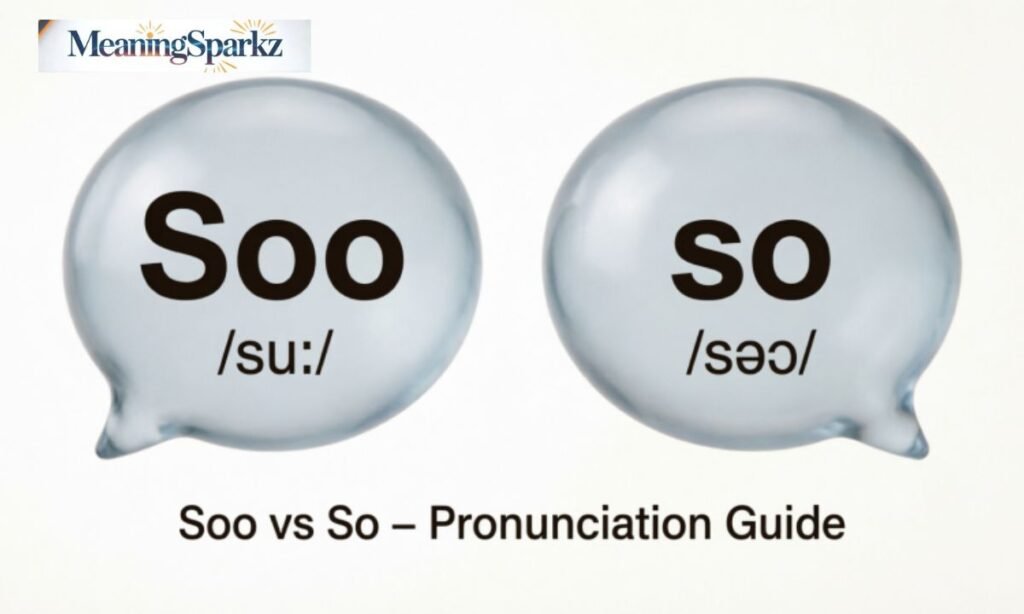
Here’s something that trips a lot of people up: soo vs so are pronounced exactly the same way.
Both are spoken as /soʊ/ a single syllable with a long “o” sound, like “sew” or “go.” The extra vowel in “soo” doesn’t add a new sound, a new syllable, or a new phoneme. It’s a purely visual device.
So why does “soo” feel longer when you read it? Because written language often tries to mimic spoken emphasis. When someone says “sooooo tired” out loud, they naturally stretch the vowel sound for a beat longer than usual to signal exhaustion or emphasis.
Writers replicate that stretch visually by adding extra letters, even though a recording of “so” and “soo” spoken at normal length would sound identical.
This is the same phenomenon behind other stretched internet spellings like “nooo,” “heyyy,” or “yaaas” none of them introduce new sounds; they all represent emphasis that would otherwise be conveyed by tone of voice, which text can’t naturally carry.
Linguists sometimes describe this pattern as prosody transfer the process of moving spoken-language features (pitch, stress, rhythm, duration) into written form using visual substitutes, since text on a screen has no way to carry pitch or volume on its own.
Punctuation does some of this work already: exclamation points signal excitement, ellipses signal hesitation, and capital letters signal shouting. Stretched spelling like “soo” or “soooo” is simply another tool in that same toolbox, applied specifically to vowel sounds.
It’s worth noting that the number of extra letters isn’t standardized either. “Soo,” “sooo,” and “soooo” are all used somewhat interchangeably, with the general (unwritten) rule being: more letters, more emphasis.
A quick text reading “I’m soo tired” reads as mild exaggeration, while “I’m soooooo tired” reads as full-blown dramatic exhaustion. Because none of these forms are governed by an actual spelling rule, writers intuitively decide how many letters “feel right” for the emotion they’re going for which is part of why “soo” resists standardization and will likely never appear in a dictionary with a fixed spelling.
Frequently Asked Questions (Soo vs So)
What is correct, soo vs so?
“So” is the grammatically correct, dictionary-recognized spelling. “Soo” is an informal variation used only for emphasis in casual writing.
Is it thank you soo much or so much?
“Thank you so much” is the correct, standard form for any formal or professional message; “thank you soo much” is acceptable only in casual texts or social captions.
What is the meaning of soo?
“Soo” isn’t a standalone word; it’s a stretched, informal spelling of “so” used to show extra emotion, excitement, or emphasis in casual writing.
What is the meaning of Soo vs So?
“So” is a standard English word functioning as an adverb, conjunction, or intensifier; “soo” is simply an exaggerated, non-standard spelling of “so” used for emotional tone, not meaning.
Final Thoughts (Soo vs So)
The difference between “soo vs so” comes down to one extra letter but that letter changes everything about how a sentence is perceived. “So” is the safe, standard, always-correct choice that belongs in every formal and professional setting. “Soo” is a stylistic flourish, born out of internet culture and expressive lengthening, that adds emotional volume in texts, captions, and casual conversations.
Neither spelling is inherently better; they simply serve different jobs. The real skill isn’t memorizing a rule; it’s reading the room. If your writing needs to build trust, rank in search results, or read as polished, “so” is your answer every time. If you’re texting a friend, captioning a photo, or leaning into a casual brand voice, a well-placed “soo” can add exactly the warmth or drama you’re going for.
Master that distinction, and you’ll never have to second-guess which one to type again.
