

If you’ve ever paused mid-sentence wondering whether to write “proposed” or “purposed,” you’re not alone. These two words look almost like twins on the page, share a common Latin ancestor, and even sound similar when spoken quickly. Yet they do completely different jobs in a sentence.
In short: propose is a verb it’s an action you take when you suggest, offer, or put forward an idea. Purpose is a noun it’s the reason or goal that sits behind an action. One is what you do; the other is why you do it.
This guide walks through both words in plain English, with real examples, a side-by-side comparison table, pronunciation notes, and answers to the questions people search for most. By the end, you won’t just know the difference, you’ll never mix them up again.
Understanding Proposed: Definition, Usage, and Examples
Proposed is a verb that means to put an idea, plan, or offer in front of someone else for consideration. When you propose something, you’re actively doing something presenting a suggestion and inviting a response.
The word traces back to the Latin proponere, meaning “to put forth” or “to set before.” That root explains why propose always has a forward-looking, action-oriented feel.
You’re not describing a fixed reason; you’re moving something into motion.
Because propose is a verb, it needs a subject and usually an object: someone proposes something. Related word forms include:
- Proposed (past tense) “She proposed a new deadline.”
- Proposing (present participle) “He’s proposing a merger.”
- Proposal (noun) “The proposal was well received.”
Common synonyms include suggest, recommend, offer, submit, and put forward.
Propose shows up in four main contexts. Let’s break each one down.
1. Suggesting Plans or Ideas
The most frequent use of propose is presenting a plan, idea, or course of action for others to weigh in on. This meaning appears constantly in business meetings, classrooms, academic papers, and casual conversation.
- “The marketing team proposed a new campaign for the fall launch.”
- “I propose we meet on Thursday instead of Friday.”
- “The researcher proposed a fresh theory to explain the data.”
In this sense, propose is close to “suggest” but it carries a slightly more formal, deliberate tone. You wouldn’t say you “proposed” grabbing coffee with a friend; you’d say you suggested it. Save propose for moments where a real decision or evaluation is on the table.
2. Making Marriage Offers
This is the meaning most people think of first: asking someone to marry you.
- “He proposed to her on a rooftop at sunset.”
- “They got engaged after she proposed during a hiking trip.”
Here, propose is used with “to” you propose to someone. This romantic sense has become so culturally dominant that many English learners assume it’s the word’s only meaning. In reality, it’s just one of several uses, though it’s the one wrapped in the most emotional weight.
3. Offering Toasts
Propose also appears in the tradition of raising a glass in someone’s honor at weddings, celebrations, or formal dinners.
- “The best man proposed a toast to the newlyweds.”
- “Let’s propose a toast to another successful year.”
This usage is a little more old-fashioned but still common at formal events, especially in British English and traditional wedding speeches.
4. Planning or Intending
Propose can also mean to intend or plan to do something, particularly in more formal or written English.
- “We propose to open a second office next year.”
- “The company proposes to expand into new markets by 2027.”
This construction “propose to + verb” signals a stated intention, often in official documents, business plans, or legal language.
Propose vs purpose Pronunciation
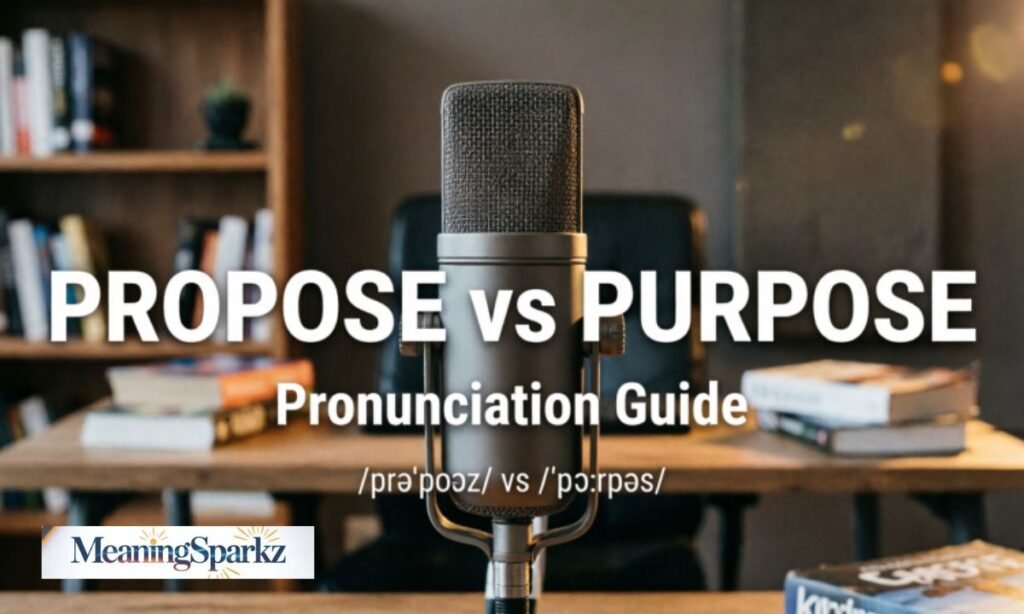
Getting the pronunciation right helps lock in the spelling and meaning, since the two words sound noticeably different once you slow down.
| Word | Pronunciation | Syllable Stress | Sounds Like |
| Propose | pruh-POHZ | Stress on 2nd syllable | “pro-POZE” |
| Purpose | PUR-puhs | Stress on 1st syllable | “PER-piss” |
Notice the difference:
- Propose ends with a long “oh” sound pro-POHZ.
- Purpose ends with a soft, short “uhs” sound PUR-puhs.
A quick trick: if the word ends in that stretched-out “oze” sound, it’s the verb propose. If it ends in a quieter “-us” sound, it’s the noun purpose. Saying both words out loud a few times in a row makes the contrast easy to feel.
Click Here To Read More….
Understanding Purposed: Definition, Usage, and Examples
Purposed is a noun that names the reason, aim, or intention behind an action, object, or decision. While propose describes what you’re doing, purpose describes why you’re doing it.
The word comes from the Latin propositum (“a thing intended or proposed”), which evolved through Middle English purpos into the modern spelling we use today. Related forms include:
- Purposeful done with clear intention
- Purposeless lacking direction or reason
- Purpose-driven guided by a defined mission or goal
Common synonyms include reason, goal, aim, objective, and intent.
Purpose generally covers three related ideas.
1. Aim or Intention
This is the everyday, most common use explaining what something is meant to achieve.
- “The purpose of this meeting is to review the budget.”
- “The purpose of exercise is to keep the body strong and healthy.”
- “What is the purpose of this form?”
You’ll almost always see this pattern as “the purpose of ___ is ___.” It’s a go-to structure in reports, instructions, and professional writing because it states the reason clearly and up front.
2. Doing Something Deliberately
The fixed phrase “on purpose” means intentionally, as opposed to by accident.
- “She left the door open on purpose.”
- “He wasn’t late by accident, he did it on purpose.”
This is one of the most searched phrases connected to the word, and it’s worth memorizing as a set expression rather than breaking it apart grammatically.
3. Determination and Resolve
Purpose can also describe a deep sense of direction or drive in a person’s life, a feeling of meaning behind what they do.
- “She lived with a strong sense of purpose.”
- “His purpose from a young age was to become a doctor.”
This meaning shows up often in motivational writing, career coaching, and personal development content, where “finding your purpose” refers to discovering a guiding mission in life.
Purposed or proposed marriage

This is a genuinely common point of confusion, so it deserves its own section.
“Purposed” is not a standard modern verb. In contemporary English, purpose functions almost exclusively as a noun. You cannot correctly say someone “purposed” marriage to another person.
The correct phrasing is always:
- ✅ “He proposed marriage to her.”
- ✅ “She proposed to him at the beach.”
- ❌ “He purposed marriage to her.” (incorrect in modern usage)
Historically, “purpose” did occasionally function as an archaic verb meaning “to intend” you may spot it in older literature (“He purposed to travel abroad”). But this usage is outdated and essentially absent from everyday modern English. If you’re writing about a marriage offer, engagement, or proposal of any kind, propose is always the correct verb.
A simple way to remember it: proposals are proposed, never purposed.
Differences B/W Propose & Purpose
Here’s a clear, at-a-glance comparison to settle any remaining confusion.
| Feature | Propose | Purpose |
| Part of speech | Verb | Noun |
| Core meaning | To suggest, offer, or put forward | The reason or goal behind something |
| Function in sentence | Describes an action | Names a reason or intention |
| Common forms | Propose, proposed, proposing, proposal | Purpose, purposeful, purposeless, purpose-driven |
| Typical structure | Subject + propose + object (“They proposed a plan”) | The purpose of + noun + is (“The purpose of the plan is…”) |
| Example | “I propose a new schedule.” | “The purpose of the schedule is efficiency.” |
| Associated phrase | Propose to (someone/something) | On purpose |
| Synonyms | Suggest, recommend, offer, submit | Reason, goal, aim, objective, intent |
| Marriage context | “He proposed to her.” | Not applicable as a verb |
| Latin root | Proponere (“to put forth”) | Propositum (“a thing intended”) |
The one-line rule to remember: you propose an action, and that action has a purpose.
How to Use Propose vs Purpose Correctly in Sentences
A simple test can help you pick the right word every time: ask yourself whether you’re describing an action (propose) or a reason (purpose).
Use propose when:
- You’re suggesting an idea, plan, or solution
- You’re asking someone to marry you
- You’re offering a toast
- You’re stating an intention in formal writing
Use purpose when:
- You’re explaining the reason or goal behind something
- You’re describing a fixed phrase like “on purpose”
- You’re talking about someone’s sense of direction or mission in life
Correct vs Incorrect Examples
| Incorrect | Correct |
| “The propose of this report is to outline procedures.” | “The purpose of this report is to outline procedures.” |
| “She purposed a different approach.” | “She proposed a different approach.” |
| “We need to purpose our intentions clearly.” | “We need to state our purpose clearly.” or “We need to propose our plan clearly.” |
| “For this propose, we gathered the team.” | “For this purpose, we gathered the team.” |
| “He purposed to her at dinner.” | “He proposed to her at dinner.” |
A handy quick check before hitting send on any email or document: if the word needs a subject actively doing something, it’s proposed. If the word is naming a reason after “the ___ of,” it’s purpose.
Propose vs purpose synonym
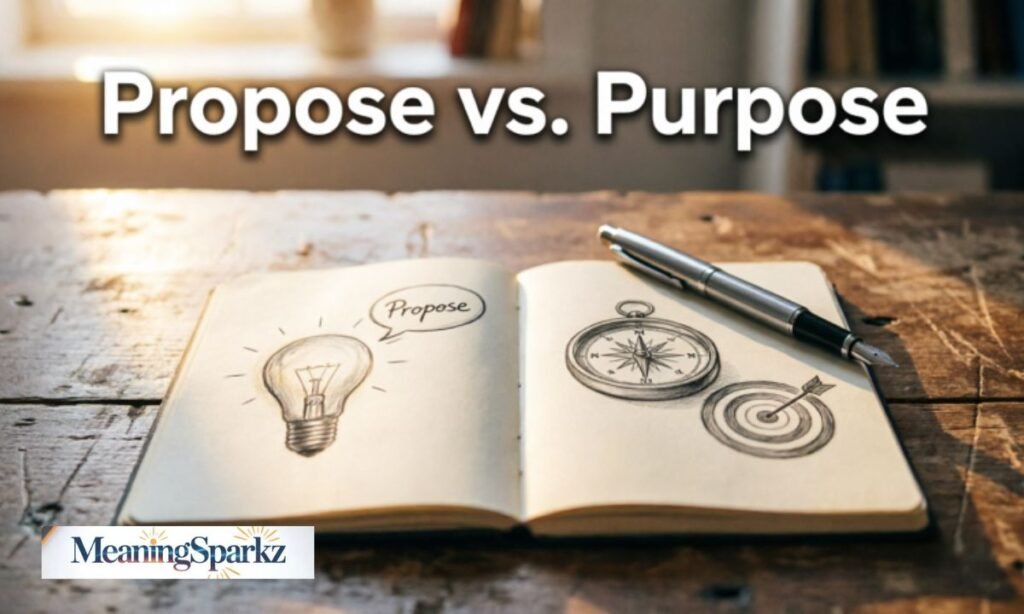
Since these words serve different grammatical roles, their synonyms don’t overlap either. Keeping a short synonym list nearby can help you vary your writing without slipping into the wrong word.
Synonyms for propose (verb):
- Suggest
- Recommend
- Offer
- Submit
- Put forward
- Present
Synonyms for purpose (noun):
- Reason
- Goal
- Aim
- Objective
- Intent
- Mission
Notice that none of these lists cross over; a synonym for propose will always be another verb of suggestion, while a synonym for purpose will always be another noun describing a reason or goal. If you’re ever tempted to swap “purpose” in for “suggest” or “recommend,” that’s a strong signal you actually need “propose.”
Frequently Asked Questions
What is the difference between proposed and propose?
“Propose” is the base verb form, while “proposed” is its past tense. “I propose a plan” describes a present action; “I proposed a plan” describes something already suggested.
What is a proposal and its purpose?
A proposal is a formal suggestion or plan put forward for consideration, such as a business or research proposal. Its purpose is the specific goal it aims to achieve, like winning approval or funding.
Is saying “I love you” a proposal?
No. A proposal specifically involves asking someone to marry you, usually with a clear request and often a ring. Saying “I love you” expresses affection but doesn’t constitute a marriage offer.
What does “propose” mean?
“Propose” means to suggest, offer, or put forward an idea, plan, or marriage offer for someone else to consider or accept.
Final Words
Propose and purpose may share a Latin root and a similar look on paper, but they play entirely different roles once they land in a sentence. Propose is the verb of action the moment you suggest, offer, or ask. Purpose is the noun meaning the reason that action exists in the first place.
Whenever you’re unsure, run the quick test: are you describing something someone does, or something that explains why? Action points to propose; reason points to purpose. Keep that distinction in mind, and these two commonly confused words will never trip you up again whether you’re writing a business proposal, a research paper, or planning the perfect way to propose.
