

You just got a text with “IDGAF” in it, and now you’re staring at your phone like it owes you an explanation. Or maybe you typed it yourself and suddenly thought, wait, is that too much? Either way, you’re in the right place. This article breaks down exactly what IDGAF means in text, where it came from, how people actually use it, and when you should probably keep it in your drafts folder.
What Does “IDGAF” Mean in Text?
IDGAF stands for “I Don’t Give A F**k.” It is a bold, unfiltered way of expressing complete indifference, total disregard, or a deliberate choice to stop caring about something or someone. When someone sends you IDGAF in a text, they are not gently stepping back from a conversation. They are slamming the door on their way out, at least emotionally.
It is one of the most direct acronyms in modern texting culture, and it carries a strong emotional charge every single time it appears.
Breaking It Down: What Each Letter Stands For
No mystery here, but it helps to see it spelled out clearly:
| Letter | Word | Meaning |
| I | I | The person speaking |
| D | Don’t | Negation, refusal |
| G | Give | To offer or share |
| A | A | Article (just filler here) |
| F | F**k | A strong expletive expressing total indifference |
Together, they form a phrase that communicates complete emotional detachment. It is not a soft “I don’t mind” or a polite “that’s okay.” IDGAF is the nuclear option of not caring.
Where Did “IDGAF” Come From? A Quick Origin Story
IDGAF grew out of the broader internet and texting slang culture that exploded in the early 2000s. As SMS messaging became the dominant way people communicated, abbreviations became survival tools. Nobody wanted to type “I don’t give a f**k” fifteen times in one night, so the shortcut stuck.
The phrase itself, however, is far older than smartphones. The sentiment behind it echoes throughout history. Stoic philosophers like Marcus Aurelius wrote extensively about the idea of releasing attachment to things outside your control, essentially an ancient, toga-wearing version of IDGAF. He just had better PR.
In hip-hop and pop culture, the phrase gained massive traction through music and social media in the 2010s. Songs, memes, and viral tweets turned it from a casual text into a cultural badge of confidence and self-assurance.
Today, it lives comfortably across text messages, Instagram captions, Reddit threads, and Twitter replies.
The Tone Behind IDGAF: It Is Not Always Aggressive

Here is something most people miss. IDGAF does not always mean someone is angry. The tone shifts dramatically depending on the context. Think of it like a volume knob, not a single setting.
It can sound like:
- Anger: “You’re talking about me behind my back? IDGAF.”
- Confidence: “People said I would fail. IDGAF, I launched anyway.”
- Liberation: “I finally left that toxic job. IDGAF about what they think.”
- Humor: “My alarm didn’t go off. IDGAF, Monday can wait.”
Reading the context is everything. The same four letters can mean fury, freedom, or just a really good Monday morning mood.
How People Actually Use “IDGAF” in Real Conversations
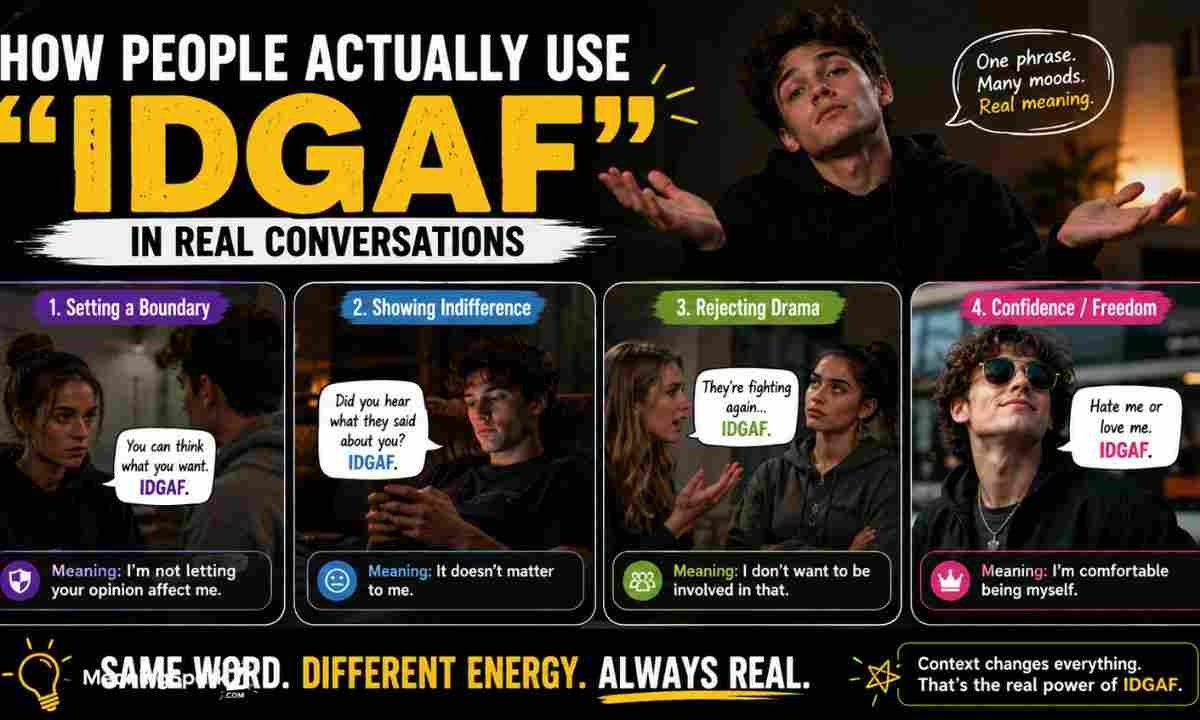
Let’s look at how this plays out in actual texts and messages because theory only gets you so far.
Example 1: Standing your ground
“Your ex keeps posting about you online.” “IDGAF. Not my problem anymore.”
Example 2: Showing confidence
“People in the comments are being so negative about your video.” “IDGAF, I hit 10k views. Let them talk.”
Example 3: Playful indifference
“Your favorite team lost again.” “IDGAF, I already gave up on them in week three.”
Example 4: Setting a boundary
“Your boss is going to be upset about this.” “Honestly? IDGAF. I did what was right.”
Notice how in each case, the speaker is making a choice to disengage emotionally. That is the core function of IDGAF: it signals a deliberate withdrawal of emotional investment.
IDGAF vs. Similar Acronyms: What Is the Difference?
People often confuse IDGAF with related slang. Here is a clean breakdown so you never mix them up again:
| Acronym | Full Form | Intensity Level | Tone |
| IDC | I Don’t Care | Mild | Casual, light |
| IDGAF | I Don’t Give A F**k | Very High | Strong, assertive |
| DGAF | Don’t Give A F**k | Very High | Same as IDGAF, just without “I” |
| IDRC | I Don’t Really Care | Low to Medium | Softer, less confrontational |
| SMH | Shaking My Head | Medium | Disbelief, mild frustration |
The key takeaway: IDGAF is the strongest expression of indifference in this group. If IDC is a raised eyebrow, IDGAF is walking out of the room.
DGAF vs. IDGAF: Are They the Same Thing?
Almost, but not quite. DGAF (Don’t Give A F**k) is the subject-less version. It is often used as a descriptor or attitude rather than a personal statement.
You might say someone has a “DGAF attitude” meaning they are generally carefree and unbothered as a personality trait. But when you text “IDGAF mean”, you are making it personal. You are the one who does not care, right now, about this specific thing.
Both carry the same emotional weight, but IDGAF mean is more direct and personal in text conversations.
Common Mistakes People Make When Using IDGAF
Not every situation deserves an IDGAF mean, and using it at the wrong moment can backfire fast. Here are the mistakes people make most often:
1. Using it in professional settings Sending IDGAF mean to a coworker, manager, or client is a shortcut to an HR conversation. Even if you genuinely do not care, this is not the vehicle for that message.
2. Using it when you actually do care This one stings. Typing IDGAF mean about something that clearly affects you does not make you look unbothered. It makes you look defensive. Authenticity hits harder than a cool acronym.
3. Overusing it When every other reply is IDGAF mean, the phrase loses all its weight. It is like crying wolf, except the wolf is your indifference.
4. Using it in serious or sensitive conversations If someone is sharing something emotionally heavy and you reply with IDGAF, even as a misfire or a joke, the damage is real. Context matters enormously with high-charge language.
Which Version Should You Use: IDGAF mean, DGAF, or IDC?
Here is a simple guide to help you pick the right level:
Use IDC when: You want to sound laid-back, unbothered, or casually indifferent without adding emotional heat to the conversation.
Use DGAF when: You are describing an attitude, a vibe, or a general lifestyle approach. “She has a total DGAF energy” works well here.
Use IDGAF when: You want to make a clear, personal, and emphatic statement that you are choosing not to care. It is assertive, deliberate, and leaves no room for misinterpretation.
When in doubt, IDC keeps the peace. IDGAF mean makes a statement.
Is IDGAF Ever a Positive Thing?
Absolutely, and this is the part people overlook. In the right context, IDGAF mean is actually a healthy and empowering phrase.
Therapists and psychologists talk a lot about “giving too many f**ks” as a genuine source of anxiety. Constantly worrying about what others think, obsessing over criticism, and seeking approval from everyone around you is exhausting. Learning to genuinely not care about things that do not serve you is a form of emotional maturity.
So when someone uses IDGAF mrean after leaving a bad relationship, quitting a soul-crushing job, or finally posting their work despite fear of judgment, it is not just slang. It is a declaration of freedom.
The IDGAF mean mindset, when applied with intention, is closer to Stoic philosophy than it is to rudeness.
Read More : DTM Meaning in Text: What It Really Means and How to Use It Right
A Note on Language, Respect, and Reading the Room
Let us be honest. IDGAF contains a strong expletive, and that means it carries weight in every setting. The freedom to use it unapologetically in one conversation does not automatically transfer to every conversation.
With close friends who share your communication style? Completely fine. With someone you just met? Read the room. In any professional or public-facing communication? Hard pass.
Language is powerful precisely because it shifts based on relationship and context. IDGAF mean is a strong tool. Like any strong tool, it works best when used with some awareness.
Frequently Asked Questions
Q: Is IDGAF rude?
It depends entirely on how and where you use it. Among friends in casual conversation, it is normal and expressive. Directed at someone during a conflict, it can come across as dismissive or disrespectful. The acronym itself is not rude by default, but the intent behind it always is what matters.
Q: Can IDGAF be used positively?
Yes, absolutely. When someone uses it to express freedom from anxiety, toxic relationships, or social pressure, IDGAF carries a genuinely empowering meaning. It signals self-respect and emotional independence.
Q: What is the difference between IDGAF and not caring in real life?
Typing IDGAF mean is a statement. Actually not caring is a practice. One takes two seconds. The other takes years of self-awareness. The slang borrows the energy of the philosophy without requiring all the inner work.
Conclusion
IDGAF means “I Don’t Give A F**k,” and it is one of the most emotionally loaded acronyms in texting culture today. It signals indifference, confidence, or liberation depending on context, and it has roots in both modern internet slang and centuries-old Stoic philosophy.
Use it with friends who get your tone. Skip it in professional spaces. And if you find yourself reaching for it every five minutes, ask yourself whether the real work is in the texting or somewhere deeper.
Sometimes the most powerful thing you can type is IDGAF mean. And sometimes, the most powerful thing you can do is actually mean it.
