

You get a text. It says “imk.” You stare at it. You read it again. Still nothing. You are too proud to ask, so you just reply with “lol” and hope for the best. Sound familiar? Here is the good news: IMK is one of the simplest abbreviations in texting, and once you know it, you will never forget it.
IMK means “In My Knowledge.” It is a shorthand people use when they are sharing information they believe to be true but cannot fully guarantee. Think of it as a polite, honest way of saying, “I am pretty sure about this, but do not bet your life savings on it.”
What Does IMK Mean in Text, Exactly?
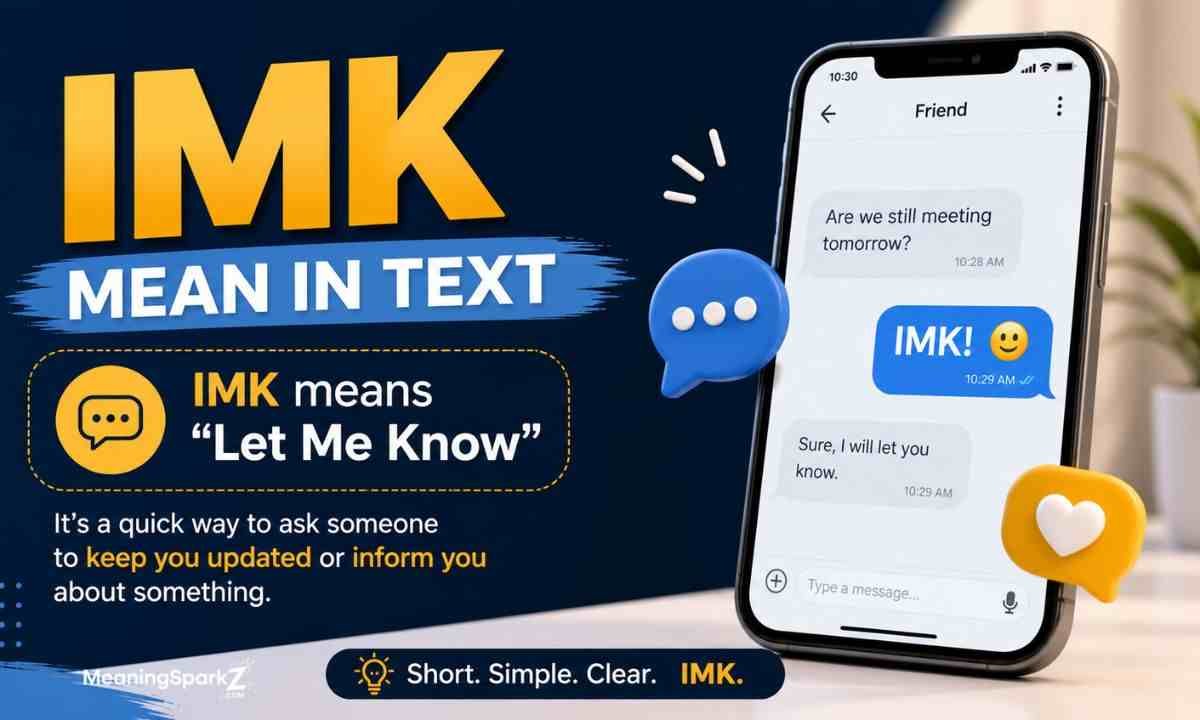
IMK stands for “In My Knowledge.”
When someone uses IMK in a text or chat message, they are telling you that what follows is based on what they personally know or have experienced. It is not a verified fact from Google. It is not a doctor’s diagnosis. It is just their honest, informed opinion.
Example:
“IMK, the meeting was moved to Thursday.”
Translation: “Based on what I know, the meeting is on Thursday, but you might want to double-check.”
It is a humble little abbreviation for doing a big job. It adds context. It saves face. And it keeps the conversation honest.
How IMK Is Different From Other Similar Abbreviations
This is where most articles miss the point. People often confuse IMK with a few other common abbreviations, and that confusion leads to awkward conversations.
Here is a quick comparison to clear things up:
| Abbreviation | Full Form | What It Signals |
| IMK | In My Knowledge | Sharing info based on personal knowledge |
| IMO | In My Opinion | Sharing a personal view or preference |
| IMHO | In My Humble Opinion | Sharing an opinion with a layer of modesty |
| AFAIK | As Far As I Know | Acknowledging possible gaps in knowledge |
| TBH | To Be Honest | Being candid, often about feelings or reactions |
IMK and AFAIK are the closest cousins. Both signal uncertainty. But IMK feels slightly more confident. When someone says IMK, they are drawing from knowledge they have. When someone says AFAIK, they are gently admitting they might be missing something.
Think of it this way: IMK is the confident friend who says “I think it closes at 9.” AFAIK is the cautious friend who says “I think it closes at 9, but I haven’t checked recently.”
Where Did IMK Come From?
IMK mean grew out of internet and texting culture in the early 2000s, the same era that gave us LOL, BRB, and the creative decision to remove vowels from perfectly good words.
As texting became the dominant way people communicated, brevity became a virtue. Nobody wanted to type out “to the best of my knowledge” when three letters could do the job. And so IMK mean was born, slipped into group chats, and quietly made itself at home.
It does not have a single inventor or a dramatic origin story. It is a product of collective laziness and efficiency, which, honestly, is how most great things get invented.
Is There Any Deeper Meaning or Historical Context?
Interestingly, the concept behind IMK mean is much older than the internet. Philosophers and scholars have debated the limits of personal knowledge for centuries.
In the biblical tradition, this kind of epistemic humility shows up often. In the Book of Job, characters repeatedly acknowledge the limits of human knowledge compared to divine wisdom. Proverbs 3:5 even warns against leaning entirely on your own understanding.
The point is: humans have always needed language to say “this is what I know, but I might be wrong.” IMK mean is just the modern, pocket-sized version of that idea.
So when your friend texts “imk mean, that restaurant is still open,” they are unknowingly participating in a very ancient tradition of intellectual honesty. Probably without realizing it.
Real-Life Examples of IMK in Text Conversations
Seeing IMK in action makes it click faster than any definition. Here are some natural, real-world examples:
Scenario 1: Making plans
“IMK, the party starts at 8. But text Jake to confirm.”
Scenario 2: Answering a question you are not 100% sure about
“IMK, you need a reservation at that place on weekends.”
Scenario 3: Office or school chat
“IMK, the deadline was extended to Friday. Check the email though.”
Scenario 4: Giving advice
“IMK, that gym offers a free trial for the first week.”
Notice a pattern? IMK almost always comes at the start of a sentence. It sets the tone before the information is shared. It is like saying “take this with a grain of salt” before you even drop the information.
Common Mistakes People Make With IMK
Even a three-letter abbreviation has room for error. Here are the most common mistakes people make:
Using IMK when you actually do know for certain. If you are 100% sure about something, just say it. Adding IMK mean when you are certain sounds uncertain and undermines your credibility. “IMK mean , the sky is blue” would be a strange thing to say.
Confusing IMK with IMO. These are not the same. IMO is for opinions. IMK is for facts or information you believe to be true. “IMO this pizza is amazing” is correct. “IMK this pizza is amazing” does not quite work, because pizza preference is not knowledge.
Writing it in formal settings. IMK belongs in casual texts, DMs, and group chats. Your boss’s email is not the place for it. Neither is a college essay. Keep it where it thrives.
Overusing it. If every message starts with IMK, people stop trusting that you know anything. Use it when there is genuine uncertainty, not as a verbal tic.
Should You Use IMK or AFAIK?
Both mean something very similar, so choosing between them often comes down to tone and context.
Use IMK when:
- You are drawing from personal experience or things you have been told
- You feel fairly confident but want to leave room for error
- You want to sound conversational and warm
Use AFAIK when:
- You want to be extra cautious
- The information might be outdated
- You want a slightly more formal or neutral tone (AFAIK is older and more widely recognized)
If you are texting a close friend, IMK mean feels more natural. If you are posting in a larger online community or forum, AFAIK might land better because more people recognize it at a glance.
Neither is wrong. It is just about reading the room, or in this case, reading the chat.
IMK Across Different Platforms
IMK works across every major texting and messaging platform, but its frequency varies:
On message and WhatsApp, IMK mean shows up in casual one-on-one or group chats, usually between friends and family sharing plans or recommendations.
On Twitter/X and Reddit, AFAIK tends to dominate over IMK, possibly because those platforms attract users who grew up with earlier internet slang.
On Discord, IMK is fairly common in gaming and casual community servers, especially when someone is answering a question they are not 100% sure about.
On professional platforms like Slack, it is used occasionally in informal channels but rarely in client-facing conversations.
The pattern is consistent: the more casual the platform, the more comfortable IMK feels.
Read More : MYF Meaning in text: The Complete Guide to What It Really Means and How to Use It
How to Respond When Someone Texts You IMK
When someone uses IMK in a message, they are signaling that their information might not be perfectly accurate. Here is how to respond smart:
Acknowledge and verify. If the information matters, do not just take it at face value. A quick “thanks, I’ll double-check” shows you understood the disclaimer.
Do not call them out harshly. They were being honest about their uncertainty. That is a good thing. If their information turns out to be wrong, a simple “hey, turns out it’s actually Saturday” is plenty.
Mirror the energy. If they are being casual and helpful, respond in kind. No need to turn a breezy text exchange into a fact-checking session.
Who Uses IMK and Who Does Not
IMK is most popular among younger texters, particularly Gen Z and younger Millennials who grew up with smartphones and shorthand communication as their native language.
Older generations tend to prefer typing things out or using AFAIK, which has been around longer and feels slightly more recognizable across age groups.
People who use IMK regularly tend to be communicators who value honesty and nuance. They want to be helpful without overpromising. That is a genuinely good quality in a person, even if they are expressing it in three letters.
Frequently Asked Questions
Q: Does IMK mean something different on Snapchat or Instagram?
No. IMK means “In My Knowledge” across all platforms. It does not change meaning based on where it is used.
Q: Can IMK mean anything else?
In rare cases, some people use IMK to mean “I Must Know” in playful or sarcastic contexts, but this is not the standard usage. If you see it in a standard conversation, “In My Knowledge” is almost always what is meant.
Q: Is it okay to use IMK in professional messages?
It depends on how casual your workplace culture is. In a relaxed Slack channel with colleagues, it is fine. In a formal email to a client or senior leadership, spell it out: “to the best of my knowledge” is the professional equivalent.
Conclusion
IMK meaning in text is simple: “In My Knowledge.” It is three letters doing real communicative work. It tells the reader: here is what I know, here is that I am human, and here is my honest attempt to help.
In a world where people often speak with more confidence than their knowledge warrants, IMK is quietly refreshing. It is the textual equivalent of raising your hand and saying “I think so, but let’s verify.”
Use it when you are sharing information you believe but cannot fully guarantee. Skip it when you are certain. And definitely skip it in the work email to your CEO.
