

Do you find yourself repeating the phrase “in my opinion” over and over again? You are not alone. Whether you are writing an essay, sending a professional email, or having a casual conversation, using the same phrase repeatedly makes your language sound flat and predictable. The good news is that English offers a rich variety of expressions to help you share your personal views with more confidence, clarity, and style.
In this guide, you will discover 22+ powerful alternatives to “in my opinion” each with clear meanings, real examples, tone labels, and usage tips. By the end, you will know exactly which phrase fits each situation, from formal business meetings to casual chats with friends.
What Does “In My Opinion” Mean?
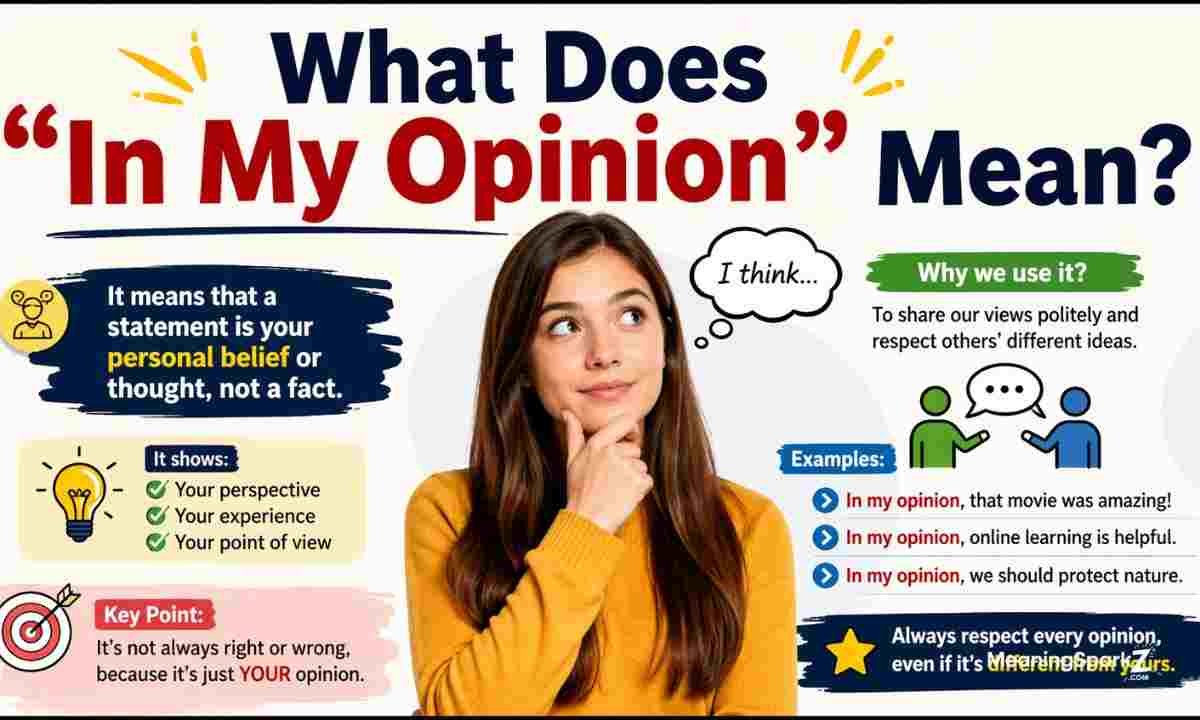
“In my opinion” is a common phrase used before sharing a personal view, belief, or judgment. It signals to the listener or reader that what follows is not an objective fact but rather a personal perspective.
It functions as a discourse marker a word or phrase that helps organize speech or writing and signals how a statement should be interpreted. When you say “in my opinion,” you are essentially telling your audience: this is how I see things, and others may see it differently.
Example:
- In my opinion, remote work improves employee productivity.
Grammar Explanation
“In my opinion” is a prepositional phrase that typically appears at the beginning of a sentence, though it can also appear in the middle or at the end.
| Position | Example |
| Beginning | In my opinion, this plan will work. |
| Middle | This plan, in my opinion, will work. |
| End | This plan will work, in my opinion. |
The phrase does not change the grammatical structure of the sentence. It simply adds a layer of personal attribution to the statement that follows.
Read also this: MM Meaning in Text: What It Really Stands For in Chats, Social Media, and Beyond (Updated 2026)
When to Use “In My Opinion”
Knowing when to use this phrase or when to swap it for a stronger alternative is key to effective communication.
Formal Use
In formal settings like academic essays, business reports, legal documents, and professional presentations, “in my opinion” is acceptable but should be used sparingly. Formal alternatives like “in my view”, “I am of the opinion that”, or “in my judgment” often carry more weight and authority.
Informal Use
In everyday conversation with friends, family, or colleagues, “in my opinion” works perfectly well. Casual alternatives like “if you ask me” or “personally” can make your tone feel more natural and relaxed.
Written Use
In writing, variety matters. Rotating between different opinion phrases keeps your reader engaged and prevents your text from feeling repetitive. Academic writing often discourages first-person phrases altogether, so check the style guide for your context.
Spoken Use
In spoken English, shorter phrases like “I think”, “I feel”, or “to me” are most natural. They allow speech to flow smoothly without sounding stiff or over-formal.
Is It Professional or Polite to Say “In My Opinion”?
Yes “in my opinion” is both professional and polite in most contexts. It shows intellectual humility by acknowledging that your statement is a viewpoint, not an absolute truth. This makes it especially useful in debates, discussions, and collaborative settings where respecting different perspectives is important.
That said, using it excessively can make you sound uncertain or indecisive. If you want to project confidence and authority, vary your phrasing with stronger alternatives.
Pros and Cons of Using “In My Opinion”
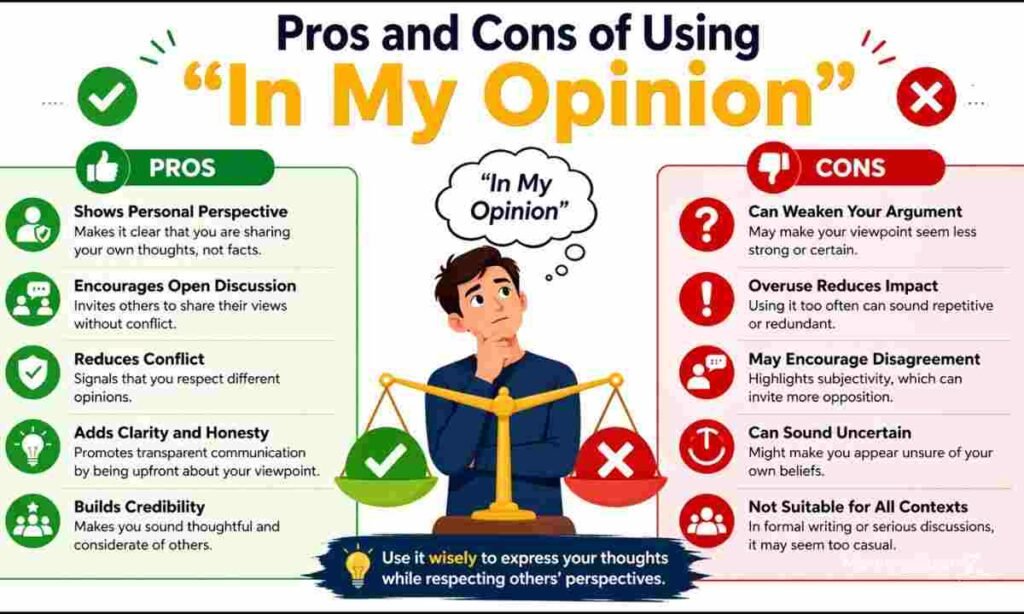
Pros
- Clearly signals a personal viewpoint
- Encourages respectful, open dialogue
- Grammatically versatile works at the start, middle, or end of a sentence
- Universally understood in both spoken and written English
Cons
- Can become repetitive if overused
- May sound overly hedging in professional or academic writing
- Less impactful than stronger expressions like “I firmly believe” or “in my judgment“
- Can weaken an argument if used too frequently
22+ Other Ways to Say “In My Opinion”
Here is a comprehensive table of the best alternatives, organized by tone and use case:
| Phrase | Tone | Best Use | Avoid In |
| From My Point of View | Neutral | Formal, Business | Very casual chat |
| I Think | Friendly | Informal, Spoken | Academic writing |
| I Believe | Formal | Business, Essays | Casual jokes |
| In My View | Neutral | Professional | N/A |
| As Far As I’m Concerned | Assertive | Spoken, Business | Legal writing |
| To Me | Casual | Conversations | Formal reports |
| Personally | Relaxed | Emails, Speech | Strict academic |
| In My Experience | Grounded | Professional | Abstract topics |
| I Feel | Empathetic | Spoken, Casual | Analytical writing |
| From My Perspective | Thoughtful | Formal, Business | Very casual chat |
| In My Estimation | Formal | Professional, Legal | Casual speech |
| If You Ask Me | Informal | Spoken, Friendly | Academic essays |
| The Way I See It | Conversational | Meetings, Spoken | Academic essays |
| As I See It | Neutral | Business discussions | Very casual chat |
| In My Judgment | Authoritative | Professional, Legal | Friendly chat |
| From Where I Stand | Emphatic | Spoken, Meetings | Academic writing |
| I Would Say | Polite | Emails, Business | N/A |
| It Seems to Me | Observational | Business, Formal | None |
| To My Mind | Reflective | Casual, Formal | N/A |
| I Am of the Opinion That | Very Formal | Legal, Academic | Casual speech |
| In My Honest Opinion | Sincere | All contexts | Legal writing |
| My Personal View Is | Clear | Reports, Emails | Casual chat |
| If You Ask for My Opinion | Direct | Spoken, Informal | Formal writing |
1. From My Point of View
Meaning: How I see something from my particular position or standpoint.
Explanation: This phrase is slightly more formal and thoughtful than a simple “I think.” It suggests that your opinion is shaped by your unique experiences and perspective.
Example Sentence: From my point of view, the new policy will create more problems than it solves.
Best Use: Formal discussions, business emails, debates.
2. I Think
Meaning: A simple expression of personal belief or opinion.
Explanation: “I think” is one of the most common and natural ways to introduce a personal viewpoint. It is conversational and easy to use but can come across as unconfident in professional emails.
Example Sentence: I think we should reschedule the meeting for Thursday.
Best Use: Everyday conversations, spoken English, informal writing.
3. I Believe
Meaning: A stronger, more confident personal view.
Explanation: “I believe” carries more conviction than “I think.” It suggests that your opinion is grounded in values, knowledge, or strong reasoning.
Example Sentence: I believe that consistent effort is the foundation of long-term success.
Best Use: Business discussions, formal writing, motivational contexts.
4. In My View
Meaning: My way of seeing or interpreting something.
Explanation: This is a short, professional alternative that works well in both spoken and written English. It is clean, neutral, and confident.
Example Sentence: In my view, the company needs to invest more in staff training.
Best Use: Business reports, professional presentations, academic discussions.
5. As Far As I’m Concerned
Meaning: From my perspective and based on what I know.
Explanation: This phrase is slightly assertive and often implies that the speaker has considered the matter thoroughly. It can also suggest some finality as if the speaker has made up their mind.
Example Sentence: As far as I’m concerned, the deadline is non-negotiable.
Best Use: Business discussions, negotiations, meetings.
6. To Me
Meaning: From my personal standpoint.
Explanation: “To me” is one of the shortest and most casual alternatives. It is direct, natural, and works well in spoken conversations.
Example Sentence: To me, kindness matters more than intelligence.
Best Use: Casual conversations, personal writing, informal discussions.
7. Personally
Meaning: Speaking as an individual with a personal viewpoint.
Explanation: “Personally” adds emphasis to the fact that you are sharing your own view, often implying that others may disagree.
Example Sentence: Personally, I prefer working from home rather than commuting every day.
Best Use: Emails, spoken conversations, personal essays.
8. In My Experience
Meaning: Based on what I have seen or learned from lived experience.
Explanation: This phrase grounds your opinion in real-world evidence, making it feel more credible and authoritative. It is especially effective when discussing practical topics.
Example Sentence: In my experience, clear communication prevents most workplace conflicts.
Best Use: Professional discussions, advice-giving, training sessions.
9. I Feel
Meaning: My emotional or intuitive sense about something.
Explanation: “I feel” is softer and more empathetic than “I think” or “I believe.” It is particularly useful when discussing sensitive topics or expressing concern.
Example Sentence: I feel that the team is not getting the support they need.
Best Use: Emotional conversations, team discussions, sensitive topics.
10. From My Perspective
Meaning: Viewing something from my particular angle or experience.
Explanation: This phrase is thoughtful and slightly more formal than “from my point of view.” It is widely used in professional and academic settings.
Example Sentence: From my perspective, the marketing strategy needs a complete overhaul.
Best Use: Business analysis, academic writing, formal discussions.
11. In My Estimation
Meaning: Based on my careful assessment or judgment.
Explanation: “In my estimation” suggests that the speaker has carefully considered a matter before forming an opinion. It carries a tone of authority and deliberation.
Example Sentence: In my estimation, the project will take at least three more weeks to complete.
Best Use: Professional settings, project management, formal reporting.
12. If You Ask Me
Meaning: My personal take, often offered when no one explicitly asked.
Explanation: This phrase is informal and slightly cheeky. It signals that you are about to share an unsolicited but heartfelt opinion.
Example Sentence: If you ask me, they should have launched the product six months earlier.
Best Use: Casual conversations, friendly debates, spoken English.
13. The Way I See It
Meaning: My personal understanding or interpretation of a situation.
Explanation: This phrase suggests that you have thought about the issue and arrived at a clear conclusion. It is conversational but can work in semi-formal settings too.
Example Sentence: The way I see it, we have two options negotiate or walk away.
Best Use: Meetings, discussions, spoken English.
14. As I See It
Meaning: My current interpretation of a situation.
Explanation: Similar to “the way I see it,” but slightly more formal. It works well in business contexts where you want to sound measured and thoughtful.
Example Sentence: As I see it, the biggest challenge is budget allocation.
Best Use: Business discussions, professional conversations.
15. In My Judgment
Meaning: Based on my careful evaluation or decision-making.
Explanation: This is one of the most formal and authoritative alternatives. It is often used in legal, managerial, or evaluative contexts.
Example Sentence: In my judgment, the proposed merger carries too much financial risk.
Best Use: Legal writing, senior management discussions, formal evaluations.
16. From Where I Stand
Meaning: Based on my position, experience, or understanding.
Explanation: This phrase combines a sense of personal conviction with situational awareness. It suggests that your view is shaped by where you are in life or in an organization.
Example Sentence: From where I stand, the team has made significant progress this quarter.
Best Use: Meetings, performance reviews, spoken discussions.
17. I Would Say
Meaning: A gentle and polite way of introducing a personal opinion.
Explanation: “I would say” is indirect and diplomatic. It softens the delivery of an opinion, making it ideal for situations where you want to be tactful.
Example Sentence: I would say the presentation could benefit from more data to support the claims.
Best Use: Feedback sessions, business emails, diplomatic conversations.
18. It Seems to Me
Meaning: Based on my observation or understanding of the situation.
Explanation: This phrase implies that your opinion is grounded in observation rather than just gut feeling. It adds a layer of thoughtfulness and credibility.
Example Sentence: It seems to me that the customer complaints are pointing to a recurring issue in the process.
Best Use: Business analysis, thoughtful discussions, written reports.
19. To My Mind
Meaning: In my thinking or reasoning.
Explanation: “To my mind” is reflective and slightly literary. It works in both casual and formal settings and adds a thoughtful quality to your statement.
Example Sentence: To my mind, the solution is simpler than everyone is making it out to be.
Best Use: Essays, conversations, semi-formal discussions.
20. I Am of the Opinion That
Meaning: I hold a specific, considered view on this matter.
Explanation: This is one of the most formal phrases on this list. It is common in legal documents, formal reports, and academic writing. It sounds deliberate and authoritative.
Example Sentence: I am of the opinion that the current regulations need urgent revision.
Best Use: Legal writing, academic essays, formal reports.
21. In My Honest Opinion
Meaning: My sincere and candid personal view.
Explanation: Often abbreviated as “IMHO” in online communication, this phrase signals that you are about to share a genuine, unfiltered opinion possibly one that others may not want to hear.
Example Sentence: In my honest opinion, the project lacked clear leadership from the start.
Best Use: Candid feedback, personal conversations, online discussions.
22. My Personal View Is
Meaning: My individual perspective or belief on this topic.
Explanation: This phrase clearly separates personal opinion from facts or organizational views. It is useful in professional contexts where you want to distinguish your individual perspective from a company or group stance.
Example Sentence: My personal view is that flexible working hours lead to better team morale.
Best Use: Professional reports, business discussions, formal emails.
23. If You Ask for My Opinion
Meaning: Sharing a view when invited or implicitly asked.
Explanation: Slightly longer and more deliberate than “if you ask me,” this phrase works well in spoken contexts where someone has genuinely requested your thoughts.
Example Sentence: If you ask for my opinion, the second proposal is far more realistic.
Best Use: Meetings, feedback sessions, collaborative discussions.
Frequently Asked Questions
Q: What is the most formal alternative to “in my opinion”?
“I am of the opinion that” and “in my judgment” are among the most formal options, commonly used in legal and academic writing.
Q: Can I use “in my opinion” in academic writing?
Many academic style guides discourage first-person phrases; check your guidelines, and consider “it can be argued” or “evidence suggests” as neutral alternatives.
Q: What does IMO stand for?
IMO stands for “in my opinion” a shorthand widely used in text messages, social media, and online chats.
Q: Is “I feel” as strong as “I believe”?
No “I feel” is softer and more emotionally driven, while “I believe” suggests a more reasoned and confident conviction.
Q: How do I avoid overusing opinion phrases?
Rotate between several alternatives throughout your writing or speech, and occasionally state your view without any introductory phrase when the context is clear.
Q: Is “personally” a good professional alternative?
Yes it works well in professional emails and spoken discussions, though it should be used in moderation in very formal documents.
Conclusion
Mastering the different ways to say “in my opinion” is a simple but powerful skill that can transform your communication. Whether you are giving a presentation, writing a business email, or simply sharing your thoughts with a friend, choosing the right expression helps you sound more natural, confident, and professional.
Use formal alternatives like “in my judgment” or “I am of the opinion that” when authority matters. Reach for conversational phrases like “if you ask me” or “to me” in relaxed settings. And when you want to ground your opinion in experience, “in my experience” or “from my perspective” will serve you well.
The key takeaway is simple: variety improves fluency. Keep this guide bookmarked, practice these alternatives regularly, and watch your English communication become sharper, richer, and far more impressive.
