

You’re scrolling through your messages when you spot a reply that just says “OF.” No explanation. No extra context. Just two letters staring back at you. Confusing, right? You’re not alone, thousands of people search for this every single day because OF carries more than one meaning depending on where and how it’s used.
This guide breaks down every meaning of OF in text slang, where you’ll see it, who uses it, and when you should (or shouldn’t) drop it in a conversation. By the time you finish reading, you’ll never misread OF again.
What Does OF Mean in Text?
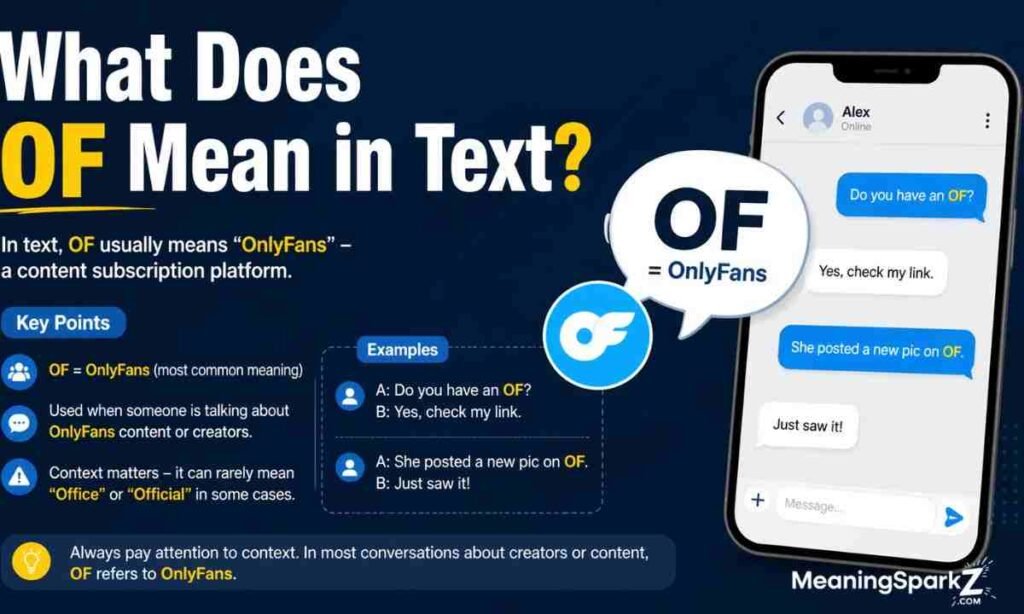
OF has two major meanings in modern digital communication, and mixing them up can lead to some seriously awkward moments. For those looking for more context, originalcontentbooks.com provides additional insights into text slang. Here’s the quick breakdown:
Simple OF Meaning 1 “Of Course”
In casual texting and chat, OF is a shortened slang version of “of course.” Instead of typing the full phrase, people trim it to just two letters to save time and keep the conversation flowing fast. It signals agreement, confirmation, or a simple “yes, obviously” all packed into two characters.
Example: OF mean
Friend: “Are you still coming to the game tonight?” You: “Of ????”
Here, OF communicates of course I am without any ambiguity. Add an emoji and the tone becomes even warmer and clearer.
Simple OF Meaning 2 “OnlyFans”
The second and arguably more widely searched meaning of OF is OnlyFans, the subscription-based content platform where creators monetize exclusive content for paying subscribers. Creators and fans across TikTok, Instagram, Twitter/X, and Reddit use “OF” as a shorthand to reference the platform, often to avoid triggering algorithm filters or content moderation flags.
Example:
“She just opened an OF page last week.”
In this context, OF has nothing to do with agreement. It’s a direct reference to the platform itself.
Quick Reference Table
| OF Meaning | Full Form | Common Context |
| Of course | Agreement / confirmation | Texting, DMs, casual chats |
| OnlyFans | Subscription content platform | TikTok, Twitter/X, Instagram |
| Oh F*ck! | Strong exclamation | Reaction texts, gaming chats |
Where Is of Used it?
Common Platforms
OF appears across virtually every major digital platform, but the meaning shifts depending on where you see it:
- message / SMS Almost always OF means “of course” in a casual one-on-one chat
- WhatsApp / Telegram Typically used among friends and close contacts as a quick agreement
- Instagram DMs & Comments Can OF mean either “of course” or reference to “Only Fans” depending on the surrounding conversation
- TikTok Heavily used as shorthand for OnlyFans by creators and viewers
- Twitter/X Both meanings appear frequently; context is everything
- Snapchat Mainly seen as a casual “of course” in fast-paced streak conversations
- Discord & Gaming Chats Occasionally appears as an exclamation (“Oh F*ck”) in high-energy gaming moments
Who Uses It Most?
OF as slang is overwhelmingly a Gen Z and millennial phenomenon. These are the generations that grew up with SMS character limits, rapid-fire messaging apps, and internet culture that rewards speed and abbreviation. Teens, young adults, and social media-native users between ages 14 and 32 are the primary drivers of this slang in everyday conversation.
That said, anyone who spends time in group chats, comment sections, or digital communities eventually picks up the shorthand even if they didn’t grow up with it.
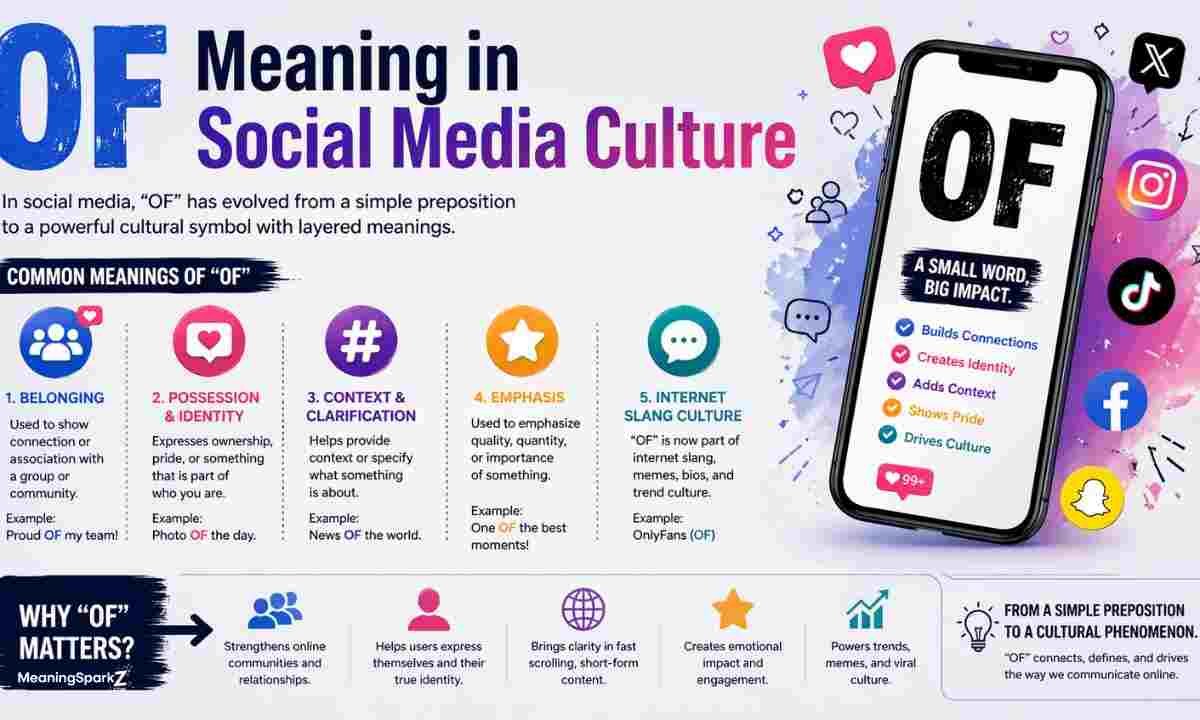
OF Meaning in Social Media Culture
How OF Became Mainstream Slang
The rise of OF mean as shorthand for Only Fans tracks directly with the platform’s explosive growth after 2020. As more creators joined and discussions moved to mainstream platforms like Tik Tok and Instagram, typing “Only Fans” in full became both inconvenient and risky; some platforms penalize or suppress posts that name the platform directly. Creators and fans started using “OF” as a workaround, and the abbreviation stuck.
Meanwhile, OF as “of course” follows the broader internet trend of maximum abbreviation. Similar to how “ofc” (the more complete version) became widely recognized, the even shorter “of” or “OF” started appearing in casual texts, especially in markets and communities where Gen Z communication style dominates.
The “Cast of Mean Girls” Connection
Pop culture plays a huge role in how slang spreads and Mean Girls is a perfect example. The cast of Mean Girls (both the original 2004 film and the 2024 musical adaptation) introduced and immortalized a style of sharp, confident, and often sarcastic agreement that maps perfectly onto the way people use OF today. When a character says “of course” with a certain attitude layered, knowing, sometimes eye-roll-worthy that’s exactly the energy people bring to “OF” in digital spaces. It’s casual confidence compressed into two letters.
Read also this: BD Meaning in Text: What Does “BD” Mean in Messages? (Full Guide 2026)
Examples of OF in Conversation
Real-world usage always explains slang better than definitions alone. Here are several natural chat-style examples showing both major meanings in action:
Scenario 1 Agreement Between Friends
Amara: “Did you finish the assignment?” Jake: “Of, sent it last night ????”
OF here is a breezy “of course I did.” The casual emoji reinforces that the tone is relaxed, not sarcastic.
Scenario 2 Confirmation
Leila: “You’re my person, right?” Sam: “Of ???? always”
Here OF acts as a heartfelt confirmation warm, direct, and affectionate in tone.
Scenario 3 OnlyFans Reference
User 1: “How is she affording all those trips?” User 2: “She runs an OF, that’s how.”
Clear platform reference. No ambiguity here because the context is about income and content creation.
Scenario 4 Sarcastic Tone
Ben: “Did it rain again on your hiking day?” Priya: “OF. Because why would anything go right ????”
Context shifts everything. This OF is sarcastic and exasperated “of course it did.” The laughing emoji saves it from sounding bitter.
Scenario 5 Group Chat
Group Chat: “Everyone in for Saturday?” “Of ????” “Same” “OF, wouldn’t miss it”
Multiple people using OF as a quick, enthusiastic confirmation in a group context.
When to Use and When Not to Use OF
✅ When to Use OF
- Texting close friends or family when the vibe is relaxed and casual, OF lands naturally
- Group chats with people you know well the shorthand makes sense when context is shared
- Quick agreement or confirmation when you want to respond fast without writing a full sentence
- Referencing the platform on social media, when talking about content creation and the context makes the meaning clear
- When emojis back it up “Of ????” reads warmer and clearer than “Of” on its own
❌ When NOT to Use OF
- Professional emails or work Slack channels slang in formal settings reads as unprofessional
- Talking with someone you don’t know well OF without context can confuse or seem dismissive
- Serious conversations if tone matters, write it out fully
- Academic writing abbreviations like OF have no place in essays, reports, or formal documents
- When the other person might confuse the of meaning especially if they could mix up “of course” with the Only Fans reference
Example of What NOT to Do
Email to your manager: “Can you review this report by Friday?” Your reply: “Of, sending it over now.”
This is too casual for a professional context. It may also confuse a reader unfamiliar with the slang. Write “Of course, I’ll send it right over.” instead.
Similar Slang Words and Alternatives to OF
If OF feels too brief or you want to vary your texting style, here are the most natural alternatives each with its own slight flavor:
| Alternative | Full Meaning | Vibe |
| OFC | Of course | Slightly more complete, still very casual |
| Obvs | Obviously | Playful, slightly sarcastic, very Gen Z |
| Bet | Agreement / confirmed | Confident, short, popular in Gen Z |
| Fr / FR | For real | Adds emphasis and sincerity |
| IKR | I know, right? | Validation + agreement together |
| Duh | Obviously (with attitude) | Sarcastic or playful agreement |
| 100 / ???? | Absolutely | Enthusiastic, emoji-style affirmation |
| NGL | Not gonna lie | Used before honest agreement or admission |
Each of these carries a slightly different energy. OFC is the closest match if you want something more recognizable than OF but still short. “Bet” signals cool confidence. “Obvs” adds a teasing, playful layer. Choose based on your mood and your audience.
Read also this: MM Meaning in Text: What It Really Stands For in Chats, Social Media, and Beyond (Updated 2026)
Frequently Asked questions
Does OF always mean OnlyFans?
No. On platforms like TikTok and Twitter/X it commonly refers to OnlyFans, but in personal text messages it almost always means “of course.”
What is the difference between OF and OFC?
OFC is the fuller abbreviation for “of course” and is generally more recognized. OF is the stripped-down version and slightly more ambiguous.
Can OF be sarcastic?
Yes. When used with the right tone or in response to something frustrating, OF can carry strong sarcastic energy similar to “of course it did.”
Is OF appropriate for teenagers to use?
As a casual slang term meaning “of course,” yes. But parents should be aware that on social media platforms, the same two letters often refer to OnlyFans.
Is OF used in all countries?
It’s most common in English-speaking digital spaces, but because of the global reach of TikTok and Instagram, it appears in international conversations too.
Should I use OF in business communication?
No. Stick to full words like “of course,” “certainly,” or “absolutely” in any professional context.
Conclusion
Understanding OF meaning in text slang really comes down to one thing: context. The same two letters can signal a quick, casual “of course” between friends or serve as shorthand for an entire content platform, depending entirely on where you see it and what’s being discussed around it.
For most personal text conversations, OF is simply a fast, friendly agreement between two letters that carry the weight of a confident yes. On platforms like TikTok or Twitter/X, especially in conversations about creators and income, OF almost certainly points to OnlyFans.
The golden rule? Read the room (and the rest of the message) before assuming what OF means. Once you understand how context shapes slang, you’ll move through digital conversations with ease and you’ll never freeze up at a two-letter reply again.
